Search by name, tag or description. Filter by category and dataset.
brandoncho369
A reflex benchmark that asks the question the demo wave mostly skips: does the simulated fly still do the things a real fly is known to do? It ships a suite of behavioural tasks with literature citations, a reference leaky integrate-and-fire simulator and a scoring harness, so any set of model parameters gets a comparable number. The framing is direct about why it exists, that every Minecraft or Doom demo had to guess at synaptic weight, global gain and inhibition and then hand-tune until something looked alive.
Evan Sinclair Smith (@evnsnclr), Georgia Institute of Technology
A Minecraft fly driven by the full retained MaleCNS graph: 166,700 neurons and 25,582,938 directed edges, with six declared in-game inputs (player approach, nearby mobs, brushing, attack attempts, food, light) feeding the model and hand-chosen readouts selecting scripted body programs. The repository is currently a landing page and roadmap: the recorded demo exists, but the Fabric mod and companion source have not been published yet. The README is explicit that this shows a visible, testable mapping, not recovered fly physiology.
 htem/BANC-project README (CC BY 4.0)
Harvard Medical School (Lee & Wilson labs), Princeton University (Murthy lab), Harvard (Drugowitsch lab)
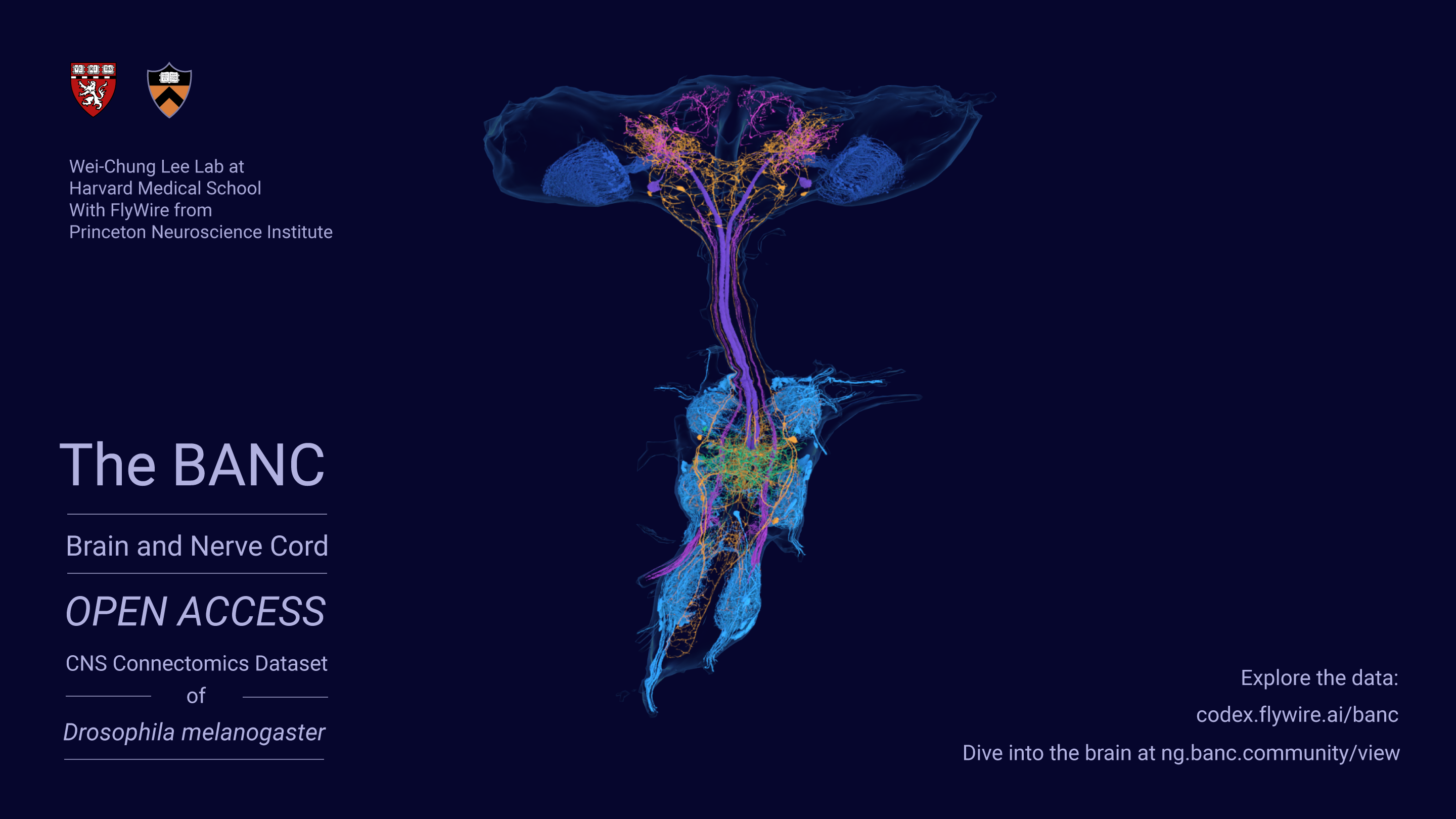
Connectome of a single adult female fruit fly imaged at 4 nm by serial-section EM, covering her brain and ventral nerve cord together at synapse resolution, which no earlier dataset had managed in one animal. The README reports about 188,000 neurons and 199 million predicted synapses; the analysis code (mostly R) and the Dataverse data are both released under CC BY 4.0. The paper by Bates, Phelps, Kim, Yang and colleagues was published open access in Nature in 2026.
 DenisSergeevitch/desktop-fly README (MIT)
DenisSergeevitch
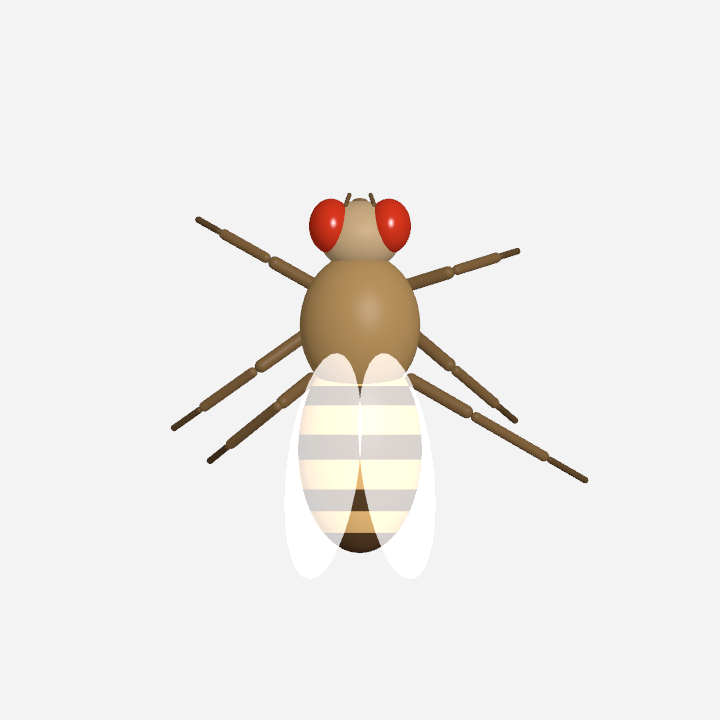
A 3D fruit fly living on the macOS desktop (Electron port for Windows), driven by a 1 kHz leaky integrate-and-fire simulation of two real circuits: a 668-neuron FlyWire subset for sensing, escape and decisions, and a 1,045-neuron MaleCNS descending-to-leg pathway ending in 220 motor neurons. Window edges act as terrain, window moves as threats and clicks as vibrations, and a separate window shows 23,210 neuron positions spiking live. The README is upfront that muscle mechanics are modeled rather than biologically calibrated; code is MIT, FlyWire data CC BY-NC 4.0 and MaleCNS CC BY 4.0.
nftechie (Alex Wormuth)
A MaleCNS v1.0 spiking simulation wired to a live Doom arena: each frame stimulates visual input neurons, activity propagates through 166,700 neurons, and motor output is decoded into movement and firing. The README is candid that learned survival has not been demonstrated yet.
Eon Systems PBC
Eon Systems' open re-implementation of the Shiu et al. (Nature 2024) leaky integrate-and-fire whole-brain model, covering roughly 138,000 FlyWire v783 neurons and 5 million synapses and runnable on Brian2 (CPU/CUDA), PyTorch, NEST GPU and GeNN backends so users can stimulate or silence any population and watch activity propagate. In a March 10, 2026 update the company reported coupling this brain to a NeuroMechFly v2 body in MuJoCo, describing grooming, feeding and foraging behaviours emerging from the closed sensorimotor loop, which it calls the first embodied fly upload.
 blendi-remade/fly-brain-minecraft README screenshot (MIT)
blendi-remade
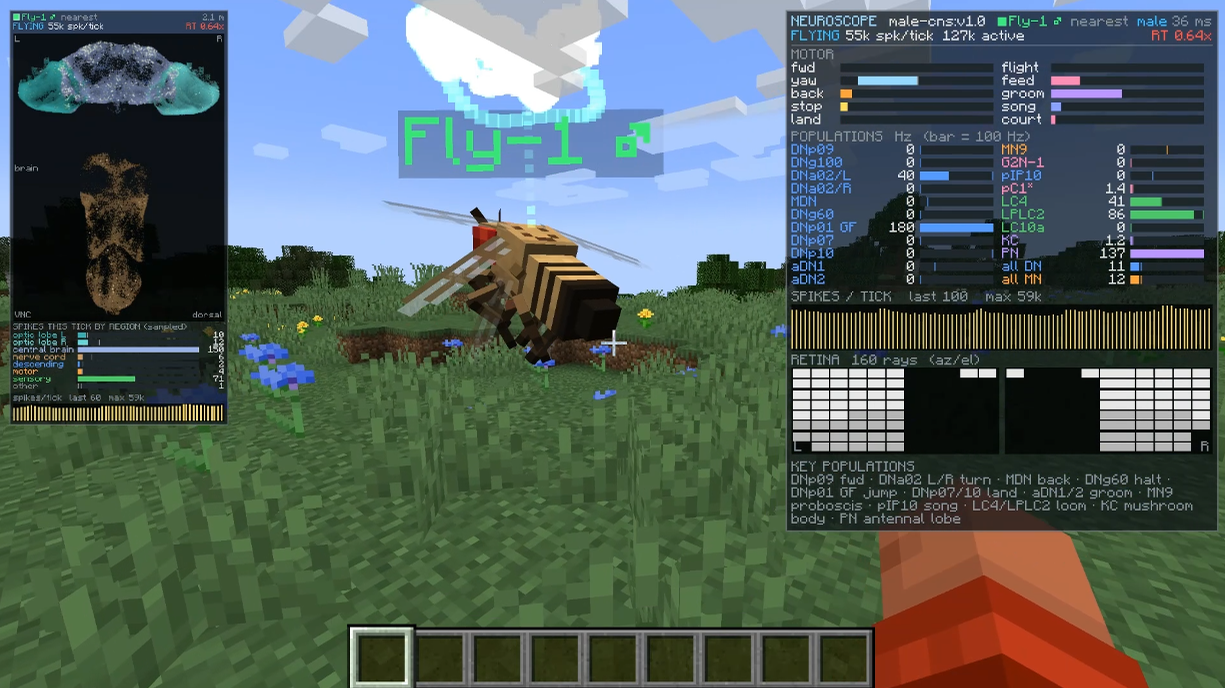
A Fabric mod for Minecraft 1.21.1 that runs the full neuPrint male-cns v1.0 connectome (about 176k neurons, 6.29M connections at 5+ synapses) as leaky integrate-and-fire units inside a fly mob, one thread per fly. In-game visual, smell, taste and touch stimuli feed sensory neurons, and decoded motor channels drive feeding, grooming, escape jumps, walking and flight. Includes a live brain-activity view, a HUD of population firing rates, and 56 JUnit tests; code is MIT, connectome data CC BY 4.0.
 TuragaLab/flybody README (Apache-2.0)
Google DeepMind / HHMI Janelia (Turaga Lab)
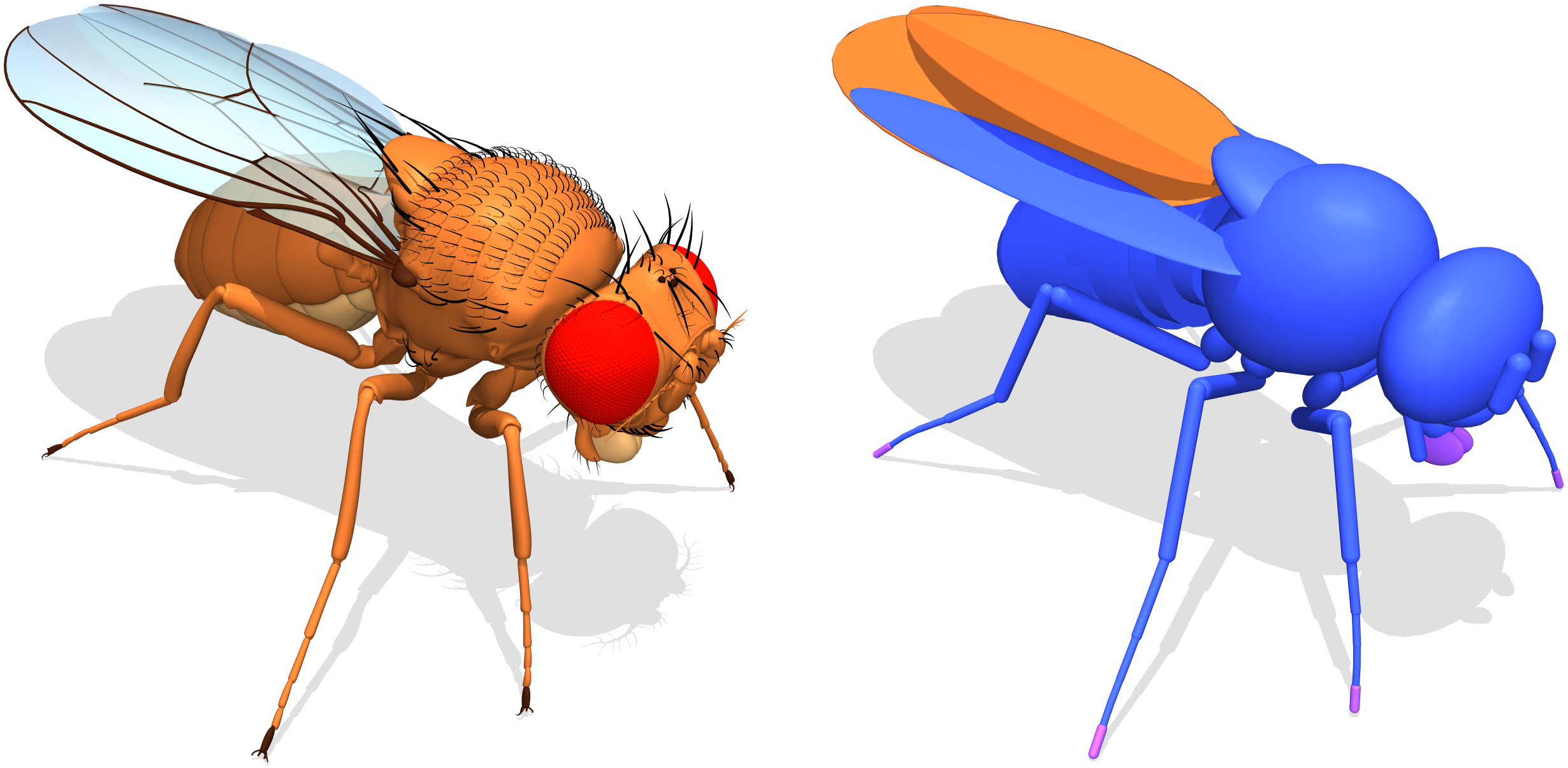
An anatomically detailed fruit-fly body for the MuJoCo physics engine, with articulated legs, wings, leg adhesion and ready-made reinforcement learning tasks for walking imitation, free flight and vision-guided flight. Published in Nature in 2025 and released under Apache-2.0.
Princeton University (Murthy & Seung labs) with the FlyWire consortium
Whole-brain connectome of an adult female fruit fly, built by AI segmentation of the FAFB electron-microscopy volume followed by community proofreading led from Princeton. Version 783, served through the Codex explorer, holds 139,255 proofread neurons and tens of millions of synapses with neurotransmitter predictions. The flagship paper (Dorkenwald et al.) appeared in Nature in 2024 alongside companion annotation papers.
University of Cambridge (Michael Winding et al.)
Complete synaptic wiring diagram of an entire insect brain, reconstructed from a first-instar Drosophila larva and published in Science in March 2023 by a team led by Michael Winding (University of Cambridge). It comprises 3,016 neurons and about 548,000 synapses, and the analysis highlighted heavy multisensory integration, interhemispheric crosstalk and recurrent circuit motifs.
HHMI Janelia FlyEM / University of Cambridge / MRC LMB / Google Research
The first complete wiring diagram of an adult male fruit fly's whole central nervous system: brain, optic lobes and ventral nerve cord in one volume, with more than 166,000 neurons. Released as open data under CC-BY, it is the dataset behind the September 2026 wave of fly-brain demos.
 navis-org/navis docs (GPL-3.0)
navis-org (Fly Connectomics group, Cambridge)
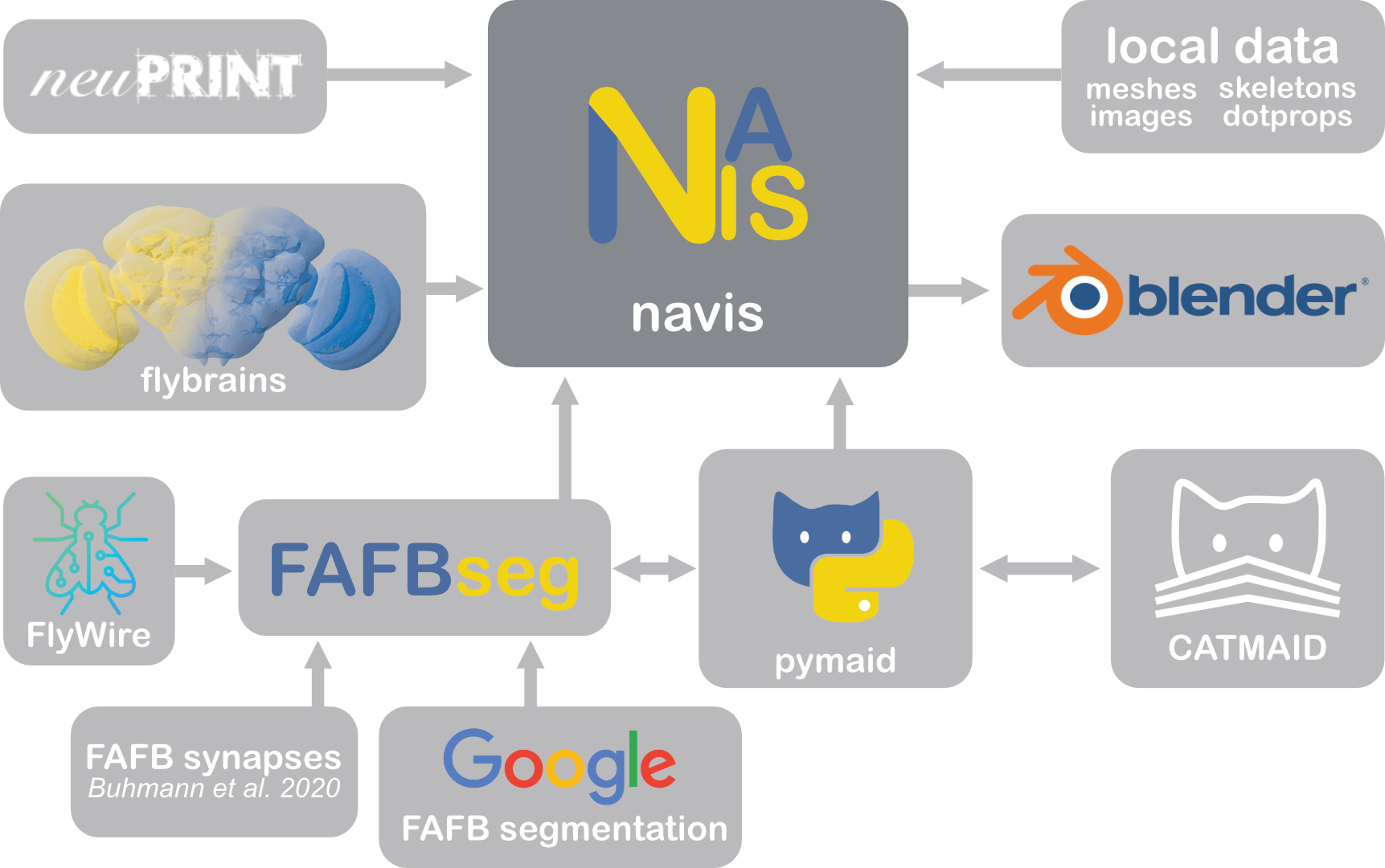
A general-purpose Python library for handling neuron skeletons, meshes, dotprops and image volumes, with 2D/3D plotting, morphometrics, NBLAST similarity and template-brain transforms built in. Developed in the Cambridge fly connectomics community as the Python counterpart of the R natverse, it plugs into neuPrint and, through the fafbseg extension, FlyWire/FAFB. Performance-critical pieces have been moved to Rust via navis-fastcore.
 NeLy-EPFL/flygym README banner (Apache-2.0)
Neuroengineering Laboratory (NeLy), EPFL
EPFL's digital twin of the adult fruit fly: a micro-CT-derived biomechanical body simulated in MuJoCo with compound-eye vision, olfaction, leg adhesion, mechanosensory feedback and a hierarchical brain/VNC control architecture. NeuroMechFly v2 was published in Nature Methods in November 2024 (Wang-Chen, Ramdya et al.), and the FlyGym 2.0 rewrite released in April 2026 brought roughly 10x faster CPU simulation and about 300x faster GPU simulation via Warp/MJWarp. It is the body used by the Eon and Rojas embodied whole-brain projects.
annel0
A fast GPU simulator for connectome-constrained spiking models of the Drosophila central nervous system, published together with a record of what it could not establish. It started from the question the viral wave skipped, that everyone reads the brain but nobody changes it, and ends by setting out in measured terms why that question cannot yet be answered honestly. MaleCNS v1.0 is imported to a CSR graph and FlyWire 783 exactly, so someone else's published predictions can be replicated; that replication lands at a median ratio of 1.01 and a correlation of 0.970 across thirteen neurons.
kevinlinxc
Plays the Bad Apple video into the MaleCNS v1.0 connectome and shows what a simulated body does in response: one pane projects neuron activity onto soma positions, the other drives a NeuroMechFly body in MuJoCo. The README opens with what it is not. The connectome is real, but the neurons are leaky integrate-and-fire units with invented parameters, not measured biophysics; the video is a spatial stimulation pattern across soma positions, not something the fly sees; there is no sensory feedback or aerodynamics; and the body mesh is the published female specimen paired with male neural data.
BruceLanLan
Takes one behaviour, looming-evoked escape gated by the giant fiber, and carries it from the MaleCNS v1.0 wiring through an explicit teacher model, then a 16-bit decision table covering all 65,536 rows, and finally a netlist of 173 NAND gates and 6 latches proved exhaustively equivalent to that table. The question is how small a deterministic machine reproduces a connectome-shaped behaviour, and how much of that machine can be proven rather than trusted. A browser bench launches a looming block at a fly and evaluates the netlist cell by cell every 5 ms, verifying its SHA-256 on load.
PtPavloTkachenko
Hologram flies placed in a real room through Snap Spectacles (2024), each running its own copy of the MaleCNS v1.0 connectome (166,700 neurons, 25.6 million synapses) as the leaky integrate-and-fire model of Shiu et al. 2024. The brains run on a Mac behind a Metal GPU kernel; the glasses turn the room into fly senses, streaming eyes, world mesh, hands and head to the brains, while descending and motor neurons come back to move wings, legs and head. The selected fly's brain is drawn live as a 16,000-neuron point cloud, and a decisions document lists every engineered part.
franciscocarloserra
Event-driven Triton kernels that step the whole MaleCNS connectome, 165,000 neurons and 24.5 million synapses, at 3,455 Hz on a single RTX 3090. With a 1 ms membrane time step that is one second of fly life in 0.29 seconds of wall clock, about 3.5 times faster than real time, against 708 steps per second for a torch.sparse COO baseline. Batching sixteen or sixty-four flies trades single-fly latency for throughput and reaches 51,159 fly-steps per second. The README is explicit that the same input produces the same spikes as the torch.sparse reference.
ashemag
An interactive 3D atlas of the adult male fly brain built from published MaleCNS geometry: 80 brain regions carrying 7,270,902 native source triangles, with exploded and paired-region views, plus 1,712 traced neurons at 2,180,126 segments and eight complete neuron meshes loaded on demand. Geometry is served locally and no API token is needed at runtime. Every asset carries its source URL and a SHA-256 checksum in an attribution manifest, and the page states that the cellular view is a selected collection illustrating morphology, not the whole population.
Mert Cobanov (@cobanov)
A browser workbench for starting your own fly-connectome experiment instead of rebuilding the scaffolding each time. It opens with 124,289 classified brain soma positions from MaleCNS v1.0 rendered without stretching the axes, plus the anatomical flybody mesh, and leaves the environment and the model as replaceable parts: training and inference stay in your own stack, and outputs are mapped back by neuron ID. The licence requires attribution in both the web UI and the repository.
hcsolakoglu
A reduced MaleCNS circuit, 4,386 real neurons and 468,923 measured edges representing 4,210,625 synapses, controls a Fruit Ninja-style game through an explicit pixel to activity to blade loop. What earns it a place is the control set: you can switch between measured wiring, rewired wiring with its own refitted readout, connections cut, blinded input, a random blade and a plain pixel heuristic, with a seed for reproducible launches. The README says outright that this is a fixed-connectivity rate model with engineered visual and motor interfaces, not a whole-brain emulation.
suanmiao
Runs the measured MaleCNS wiring, 165,122 neurons and 25,563,197 synapses, as a recurrent network and trains it to steer a car from a 64 by 32 pixel windscreen. The adjacency never changes; what is learned is one gain per synapse and one leak per neuron. On held-out streets with parked cars, oncoming traffic and a slow car to overtake it completes 58 of 60 runs across three independent sets with no collisions against any car. The site replays logged state rather than re-simulating, puts the real input beside the drive, and publishes the failures too.
fazchile17
A local 3D viewer of the FlyWire FAFB v783 connectome, 139,255 neurons, 15,091,983 directed pairs and 54,492,922 contacts, that paints either the Bad Apple!! animation or the shareware episode of DOOM using nothing but neurons as pixels. After a one-off data preparation of roughly 3 GB the viewer runs entirely offline on localhost; only the outbound links to Virtual Fly Brain and FlyWire need the network. Documentation is in Spanish. One of two independent Bad Apple entries from the same week.
Yusuftmle
An agent that plays Valve's Half-Life with no deep network, policy or reinforcement learning in the loop: every turn, jump and evasive move comes out of biophysical leaky integrate-and-fire circuits derived from MaleCNS v1.0 and FlyWire and simulated as sparse tensors. Frames are projected onto a 60x60 compound-eye retina and taking damage triggers a giant-fiber escape. The headline figure is the size of the source dataset; the graph actually stepped in the demo is a 12,260-neuron subgraph, shown beside the game with calcium-style activity and descending-neuron meters.
nicodunks
A paired experiment on the MaleCNS wiring graph (166,606 classified neurons, roughly 25.6 million connections) asking whether blocking the output of the inhibitory mAL pathway lets male-associated sensory input reach courtship-related P1 neurons. Both arms get identical inputs and the same firing rules; the only change is the mAL block. All 36 combinations of three input pathways, three seeds and two inhibition settings were run, and the README states plainly that the cell identities and connection effects stay modelling assumptions rather than measured properties.
shakeabhishek
A physical hexapod robot whose escape behaviour comes from fly wiring rather than a hand-written state machine or an abstract neural network. Only the direct one-hop synaptic neighbourhood of the giant-fiber escape circuit is pulled out of the MaleCNS reconstruction through Virtual Fly Brain, roughly 391 neurons including LC4 and LPLC2 looming detectors and JO mechanosensors, and simulated in Brian2 on a Raspberry Pi 5. A camera and OpenCV optical flow feed the spike encoder, and a decoder drives eighteen servos through a PCA9685 controller: a connectome on real hardware, not in a simulator.
Erfara Labs (@erfaralabs)
Injects a Drosophila connectome graph of 28,994 neurons and 1,814,208 directed synaptic edges into layer 16 of SmolLM2-360M as a persistent leaky-integrator reservoir, without retraining the graph. In-degree normalisation holds the unweighted graph near criticality (largest Lyapunov exponent +0.0309, branching ratio 1.0220). The claim is tested against a degree-preserving null: scrambling the biological targets costs 0.0781 nats of cross-entropy, about 1.58 per cent. The README calls the graph hemibrain plus ventral nerve cord but never names the released dataset behind it.
Roxx0x
Uses the larval fruit fly connectome of Winding et al. 2023, 2,952 neurons and about 110,000 connections, as a fixed reservoir. The wiring is never modified, because you cannot edit an animal's connectome; only a one-layer linear readout is trained on the activity it produces. On handwritten digits that readout reaches 94 per cent against a 10 per cent baseline. It installs with pip, downloads the connectome once and exposes digit and time-series tasks behind a small API.
ASCII.jp (G.Raymond)
Japanese coverage devoted to NeuroCraft Fly specifically. It reports the six input types the Minecraft fly responds to (player proximity, surrounding mobs, brushing, attacks, food and light), notes that selected readouts pick predetermined actions rather than simulating natural physiology, and states the release position clearly: the repository holds introductory materials and demo footage, with the Fabric mod source still unpublished.
AUTOMATON (Kosuke Takenaka)
A Japanese games-press account of DOOMFLY, focused on the mechanism rather than the spectacle: Doom's screen becomes signals the fly can receive, activity runs through the MaleCNS v1.0 model, and taking damage sends an aversive stimulus to dopamine cells. Its most useful line is the negative result, that after roughly 3,000 attempts no learning had been confirmed in the form of longer survival.
Mert Cobanov (@cobanov)
A curated list of fly-connectome projects published on 12 September 2026, at the peak of the wave, grouped into games and control experiments, desktop flies and interactive worlds, language and art experiments, brain models and embodied simulation, datasets, analysis libraries and tutorials. Each line names the dataset used and flags whether the project runs a whole connectome or only a circuit subset, which makes it unusually useful for telling the serious entries apart from the quick ones.
Buzzback (zormy111)
The neuroscience core of a token project: it simulates the complete FlyWire female brain (138,639 neurons, 15,091,983 synaptic rows) as a leaky integrate-and-fire network, stimulates the sugar-sensing gustatory receptor neurons and reads out the proboscis-extension motor neuron MN9, whose firing triggers an on-chain buyback in production. The repository publishes the model, the calibration and a demo video; the code is the interesting part, and this listing covers the code, not the token.
Listed for information only. No endorsement, no referral links.
ZeroXClem
Closes the sensorimotor loop in the browser: rendered images drive a compound eye sampled at the connectome's 1,771 column directions, the optic-lobe rate model feeds the whole MaleCNS graph, descending-neuron rates drive the wings, and the body's new pose renders the next frame. It is an explicit combination of two upstream projects joined at MaleCNS body IDs, AbijahKaj's optic-lobe front end and Xenova's whole-CNS WebGPU back end, and it ships an ablation bench that produced the published cruise figures.
Unjuno
Connects the MaleCNS v1.0 connectome to the FightingICE fighting-game platform through a pinned implementation of the Shiu et al. leaky integrate-and-fire dynamics. Game observations become a versioned Poisson sensory interface, real output-body spike counts become versioned action groups, and a public research ledger records the runs. The repository draws an unusually sharp line between what is biological data (the anatomy), what is a published model (the dynamics) and what is a project-defined interface (the sensory and action mappings, reward and plasticity rules).
Yijie Yin, University of Cambridge
A Python library that turns a wiring diagram into testable hypotheses about circuit function, and it runs on a laptop or in Colab even for whole-brain analyses of around 140,000 neurons. It computes polysynaptic effective connectivity between groups of neurons with or without signs, retrieves and plots the actual subcircuit between sources and targets, and exposes a differentiable connectome model. Installable from PyPI, with an accompanying preprint and Colab notebook.
Dexerto (Zackerie Fairfax)
The article that gave the wave's counter-current a name. It covers Macroblock's announcement of an open-world sim where the simulated fly gets grass, trees and endless fruit instead of Beat Saber, sets it against NeuroCraft Fly and the rhythm-game clip, and notes that the Beat Saber demonstration was later clarified as incomplete, a useful correction given how often that clip's view count is cited.
eonfathom (Michael)
A GPU simulator aiming at real-time or faster execution of the whole FlyWire brain, 139,255 neurons and 54.5 million synapses, on a single consumer NVIDIA card. The engineering is the point: leaky integrate-and-fire neurons, CSR sparse connectivity with FP16 weights, a push model that only processes synapses of neurons that actually fired, warp-ballot spike detection with bit-packed flags, and warp-per-spike load balancing. Connectivity comes from Shiu et al.'s v783 release and annotations from flywire_annotations.
nftechie (Alex Wormuth)
Couples a frozen language model to the retained MaleCNS v1.0 graph: token embeddings drive the fixed 166,700-node network, and a 278,528-parameter adapter reads its state to adjust the next-token scores of Liquid AI's LFM2.5-1.2B-Instruct. Only the adapter trains, against a parameter-matched direct-input control. The README puts the caveat in its first paragraph, that language ability comes from the pretrained model and this does not mean a biological fly understands language.
Artem X (@artem-x-meta)
Combines a NeuroMechFly body in MuJoCo with MaleCNS connectome data and explicit behavioural controllers. The hybrid mode covers walking, odour-guided food search, contact feeding through an articulated proboscis, grooming, sleep pressure and waking; a separate two-fly arena adds shared food, body collisions, pushing, foreleg fencing and retreat. The README states that the demo clips were recorded with the connectome disabled, showing the engineered controllers, and that this is an experimental model rather than a validated digital fly.
Liu Zihe (@liuzihe02)
Puts a connectome simulation into Craftax, an open-ended survival environment, and trains a linear descending-neuron readout with PPO. What sets it apart from most of the wave is the harness around it: a brain-only throughput benchmark, an MN9 sugar-response check against Shiu et al., a calibration sweep over lamina bias and synapse weight, zero-shot rollouts against ablation controls, and a replay of the trained readout on a held-out key versus an open-loop baseline. A research prototype, not a result.
Mert Cobanov (@cobanov)
The original Chromium Dino game played through an 80-cell measured MaleCNS circuit: eight engineered observations feed the fixed cells, 16 descending-cell activities feed a 16-12-3 readout, and only that 243-parameter readout is trained, using the cross-entropy method over 80 generations and 15,680 episodes. The published checkpoint clears 99/100 held-out 180-second courses; the same readout with the circuit silenced clears 0/100. The author states this shows learned control and dependence on circuit activity, not that biological topology is better.
David Zhang (@dzhng)
A 3D browser puzzle game: arrange household objects in a furnished house, release a swarm of flies, and see how many find the exit before time runs out. Each fly has its own simulated activity from a selected part of the MaleCNS connectome, running as Rust compiled to WebAssembly with a TypeScript world and interface; you can follow one fly, read its left/right color inputs and inspect its neural traces. The stated design rule is to build the game around observed behavior rather than forcing the neurons to produce a chosen strategy.
Matty (@mattyhempstead)
"Born to fly. Forced to scroll." A simulated fly watches an endless feed of insect Shorts on a virtual phone: the browser samples the phone image at 90x160 pixels, luminance and color stimulate 3,335 R1-R6 and 811 R8 inputs in the full MaleCNS v1.0 graph, and a compiled kernel advances 50 ms of neural time per accepted frame. The overlay charts the measured PAM11 dopamine firing rate in Hz alongside whole-network spike counts. Explicitly inspired by Stonkfly; body motion is an amplified readout, not a physics simulation.
Mehran (@mehrantsi)
A native Rust and Metal implementation of the published FlyWire leaky integrate-and-fire model, with Python kept as an independent Brian2/NumPy verification lane and as the offline Parquet-to-CSR compiler. It now carries a Rust embodiment layer too: MuJoCo runs an exported NeuroMechFly body behind a fixed-rate sensory bridge and a native viewer. A separate experimental integration connects MaleCNS v1.0, 166,700 neurons and 24,469,412 signed edges including the nerve cord, adding no cross-specimen wiring. A paired control run disconnects the motor readout while the neurons keep running.
Furkan Çakır (@furkancak1r)
A first-person horror prototype in Godot 4.5 where a physical fly shares the room with you: a MaleCNS v1.0 simulation (166,700 neurons, 25,582,938 directed connections) influences its flight while a separate reward-updated decision layer picks which scare events fire. The repository ships the built game, the data, a separate Python simulation, tests and measurement reports, and documents a pre-training run of 48 synthetic players over 576 rounds. The README is in Turkish.
Mark Unthank (@MarkUnthank)
Trains a model built from 165,122 traced MaleCNS neurons and 25,563,197 measured connections to physically operate a steering wheel through a simulated fly foreleg, then drives a car in CARLA. The reported pilot passed 100/100 held-out stationary steering targets after 600 optimizer updates and 0/100 before, with a worst hold error of 4.85 degrees against a predeclared 7.45-degree limit; removing the foot grip removes over 99 percent of the steering response. The README states that visual driving, combined wheel and pedal control, and three-seed replication remain untested.
tel∅s (@tel-0s)
Gives the MaleCNS v1.0 connectome colour vision, smell, taste and wind sense, a body that walks, jumps and flies, and a room with a table and fruit on it. The console shows a body camera, an orbit view, both retinal mosaics, antennal inputs and simultaneous population, motor and body readouts, with switches for simulated central-complex steering, anemotaxis and escape gating. The connectome is never trained or edited; everything else rests on a documented set of physiological assumptions.
Turaga Lab, HHMI Janelia Research Campus
The official PyTorch implementation of Lappalainen et al., "Connectome-constrained networks predict neural activity across the fly visual system" (Nature, 2024): a deep mechanistic network of the fly visual system whose connectivity is fixed by the connectome while its parameters are trained on an optic-flow task. The wiring ships with the package as a FIB-25/FIB-19 medulla reconstruction, not one of the whole-brain datasets. It includes pretrained model ensembles, Colab tutorials and a framework for custom models; several browser demos in the September 2026 wave use it as their eye front end.
flywheel-sol
A blackjack dealer whose hit-or-stand decision on hands of 12 to 20 comes from one stimulation of a FlyWire v783 leaky integrate-and-fire simulation (138,639 neurons, 15.09 million synapses) with Shiu et al. 2024 parameters, read out at the proboscis motor neuron MN9. The repository ships the model, the measured calibration, a negative control and a script that replays any hand played on the site, so a player can verify which code decided it. Listed for the verifiable-decision machinery, not the token.
Listed for information only. No endorsement, no referral links.
 @sainimatic on X (photo, 2026-09-13)
Macroblock (@sainimatic)
A counterpoint to the wave of games that put the simulated fly through hostile environments: Macroblock announced a sim where the fly simply flies around and feeds forever among grass, trees and endless fruit. The post drew roughly 24,000 likes and was picked up by Dexerto and IBTimes as the trend's ethical reaction shot. The post announces work in progress, so which connectome it uses and how far it got are not established by the sources checked.
GIGAZINE
Japanese-language coverage of the wave, published six days after the MaleCNS release. It walks through Alex Wormuth's Doom experiment (including the PPL101 dopamine cells stimulated on damage), Jessica Paquette's Super Mario 64 controller, Evan Smith's NeuroCraft Fly in Minecraft and a Bad Apple!! visualisation, and closes on the point most of the wave elides: the connectome shows structure and connections, not a complete functional replication of the biology.
Google Research (Michał Januszewski, Viren Jain)
The release-day post from the Google Research side of the collaboration, describing the male central nervous system reconstruction as the largest brain map by neuron count to date: over 166,000 neurons and 125 million synaptic connections, led by HHMI Janelia with Google Research and academic collaborators, published in Cell as a study of sexual dimorphism. It points to the Janelia download page and to Neuroglancer for viewing the volume. This is the announcement the entire September 2026 demo wave grew out of.
William Kelly (@cnqso)
A browser artwork rather than a game: 139,255 FlyWire neurons drive an embodied fly in a terrarium whose sweet-sensing neurons receive continuous stimulation, so it feeds forever. Feeding, head and antennal motion follow neural activity, while wing movements and small foot shuffles use supplied patterns; a corner map lights up sampled FlyWire positions as neurons fire. The author credits Harris Rosenblum's Infinite Pain (2025) as the inspiration and lists flybody, MuJoCo and Shiu et al. as the body and model references.
Lulzx
An embodied whole-CNS simulation that runs in a desktop browser: a 165,122-neuron MaleCNS v1.0 brain in a MuJoCo flybody body with a flyvis-trained compound-eye front end. Four views ship together, a connectome viewer with stimulable cell types, an algorithmic-structures page (ring attractor, expansion coding, motif census), an arena where you place sugar, odour and threats and watch a fly's brain in an inset, and an anatomy viewer. An endogenous-activity module supplies the spontaneous drive the connectome model lacks, entering only as synaptic input to identified descending neurons.
Reiser Lab, HHMI Janelia Research Campus
A browsable reference for the MaleCNS v1.0 cell types, generated from the dataset itself and published by the lab: one page per cell type with connectivity, region innervation and morphology. It is the resource the demo projects should be checking their named neurons against, since almost every game demo picks out descending neurons such as DNp01 or DNg100 by name without a way to see what those cells actually connect to.
Pandu Sastrowardoyo (@Decentricity)
Drives a sparse MaleCNS reservoir with a live Muse EEG headset and renders the result in the terminal through libcaca, with a human scalp and band pane next to the fly visualisation. A synthetic EEG source lets it run without a headset. The README sets its own limits clearly: the reservoir dynamics are not biophysics, and the "fly EEG bands" are the spectral content of the digital reservoir rather than insect electrophysiology.
Xenova (Hugging Face)
A standalone Hugging Face Space where you paint neurons, stimulate the network and watch an articulated Three.js fly respond, all locally in the browser. It retains 166,700 MaleCNS entries and 25,582,938 directed connections and runs a leaky integrate-and-fire model adapted from Shiu et al. on WebGPU kernels, with a JavaScript fallback. The card is candid that the walking, turning and flight animations are crafted and illustrative, that gains and thresholds were chosen for the demo, and that body motion never feeds back into the network.
marketcalls
The trading branch of the wave, aimed at the Indian options market instead of crypto: the full MaleCNS v1.0 simulation is wired through OpenAlgo to one strategy, an intraday short straddle on the current-month NIFTY expiry, sized with volatility-based stop losses and flat by 15:15 daily. Prices and option chains come from the user's own OpenAlgo connection into a local DuckDB, with no mock data. Paper mode is the default, live mode needs an explicit opt-in, and the README states that no profitable edge has been demonstrated.
 ▶
▶Ro0oney (YouTube)
The YouTube video Know Your Meme credits as one of the earliest large posts of the September 2026 wave, with over 241,000 views in three days. The creator wires a fly connectome model to the behaviour of a Minecraft mob, first a spider and then a bee. The title's talk of transferred consciousness is showmanship: coverage describes a model of neural connections with a program mapping neurons to in-game decisions, and neither the dataset version nor the neuron-to-action mapping is documented in the sources checked.
hrook1
A browser arcade game where you try to swat a fly and watch its escape circuit light up before you click. It runs a simplified spiking model of 6,000 traced MaleCNS v1.0 neurons and 1,275,994 directed connections (preserving 10,659,685 original synaptic contacts), feeding simulated vision into an extracted LC16-to-MDN retreat circuit whose activity influences evasive turns and bursts. Baseline cruising, flight animation and collision rules are authored game mechanics, and the README says so plainly.
Ahmet Barış Günaydın (@abgnydn)
Fire a real descending neuron in the FlyWire connectome and watch the spike cascade propagate through the wiring into MANC nerve-cord data; what comes out is a walking magnitude and a turn bias that modulate a hand-written tripod gait. It runs entirely in the browser on WebGPU with no install, and ships a separate science view. The README labels the motor mappings as explicit approximations, and the project predates the September 2026 wave by several months.
 ▶@_lyraaaa_ on X (video poster, 2026-09-12)
@_lyraaaa_
A short video posted on X by @_lyraaaa_ showing a simulated MaleCNS v1.0 fly brain hooked up to Beat Saber. It carries the highest view count Know Your Meme lists for the September 2026 wave, roughly 22 million views and 84,800 likes. Dexerto reports that the creator later clarified the video does not yet show the model independently playing: its motor system had been trained to reproduce a recorded sequence, while visual reactions and actual playing patterns were still being developed through reinforcement learning. Read the view count with that in mind.
 ▶@nftechie_ on X (video poster, 2026-09-12)
@nftechie_
A video post by Alex Wormuth (@nftechie_), the creator behind the earlier Doom livestream, giving a simulated fly brain $100 and using its neural activity to trigger buy and sell orders on Coinbase, with dopamine neurons stimulated whenever it profits. Know Your Meme reports about 3.4 million views. The author published Stonkfly the same day: prices become an RGB chart stimulating 3,335 brightness and 811 R8 inputs in the MaleCNS graph, a fixed readout proposes buy, sell or hold, and profit or loss stimulates PAM11 or PPL101 cells. It paper-trades by default and shows no profitable learning.
 natverse/coconatfly README (GPL-3.0-or-later)
Gregory Jefferis (natverse)
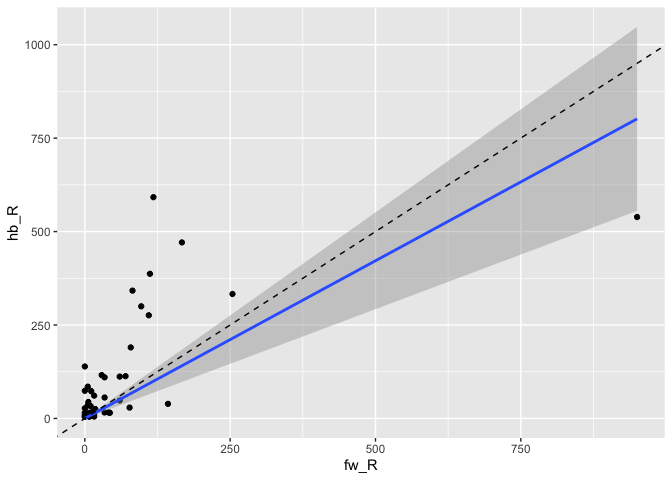
An R package from Greg Jefferis that puts one uniform interface over the major fly connectomes so the same partner-query or cell-type comparison can be run across hemibrain, FlyWire, MANC, FANC, BANC, the male CNS and the male optic lobe. It is flagged as experimental and its API may still change, but it is already the workhorse for hemibrain-versus-FlyWire comparisons in the natverse community.
Yijie Yin, University of Cambridge
Yijie Yin's (Cambridge) notebooks and scripts for turning raw connectome releases into analysis-ready sparse connectivity matrices and metadata tables, with axon/dendrite splitting via flow centrality. It covers the adult male CNS, BANC, FlyWire/FAFB, hemibrain and MANC as well as the larval connectome, and includes benchmarking code for the pathfinding and effective-connectivity analyses used in the Connectome Interpreter framework. No license file is present.
 erojasoficial-byte/fly-brain README demo GIF (MIT)
Enrique Rojas Aliaga, Universidad de San Martín de Porres
A solo project from Enrique Rojas Aliaga at Universidad de San Martín de Porres (Lima) that wires a spiking network of 138,639 FlyWire v783 neurons and 15.1 million synapses into a NeuroMechFly v2 body in MuJoCo, complete with compound eyes, legs and wings. The author reports vision-driven motion detection, olfactory chemotaxis, gustatory responses and emergent walking, flight and escape, and frames the work around how connectome plus embodied experience yields individual behavioural differences; a 2026 preprint is archived on Zenodo.
Harvard Medical School (Wei-Chung Allen Lee lab)
GridTape-TEM volume of an adult female fruit fly's ventral nerve cord from the Lee lab at Harvard Medical School, with automated reconstruction and an ongoing community proofreading effort. The original EM dataset was described in Cell in 2021, and the connectomic reconstruction (Azevedo, Lesser, Phelps, Mark et al.) in Nature in 2024. This repository hosts the pip-installable fanc-fly Python package (GPL-3.0) and the project wiki, which fanc.community redirects to.
 sjcabs/fly_connectome_data_tutorial (MIT)
SJCABS winter school (Sven Dorkenwald & Alexander Bates)
Course material from the San Juan Winter School on Connectomics and Brain Simulation, written by Sven Dorkenwald and Alexander Bates, that walks students from loading data to morphology, direct and indirect connectivity analysis in both Python and R. Its most useful feature is a harmonised metadata schema and a public cloud bucket covering BANC, FAFB, the male CNS, MANC and hemibrain, so the same notebooks run across all five datasets.
caparison1234
A Python project that runs 1,373 neurons and 22,400 synapses from the Winding et al. 2023 larval Drosophila connectome as LIF units and lets them drive a real-time MuJoCo larva body. Note the front end: a small Qwen2.5 0.5B language model converts typed text (English, Korean, Japanese or Chinese) into sensory drive, so 'danger' activates nociceptors and produces retreat or curling, and 'food smell' produces head scanning; the connectome itself is not perceiving anything. All 17 commits date from 2026-03-21, well before the September wave; no license is stated.
ad7584
A token experiment: a Python simulation of 165,122 neurons from the September 2026 male CNS connectome is wired to token-launch platforms on Solana and Robinhood Chain. Market signals such as momentum and liquidity are mapped onto sensory populations, and launch or abort decisions are read from command neurons with known roles (proboscis extension means launch, the giant fiber escape circuit means abort). Single-commit repo with no stated license; the same account also authored commits in flycoinrh.
Listed for information only. No endorsement, no referral links.
fruitflydev
A token experiment in which a neuron-by-neuron simulation of the 165,122-neuron male connectome (data pulled from the public CC-BY cloud bucket) drives a browser: screenshots pass through 892 retinotopic columns, activity propagates across the network, and motor output moves a cursor on a launchpad on Robinhood Chain, an Arbitrum-based L2. Later commits add dopamine-gated Kenyon-cell plasticity, an autonomous browsing mode and a narrator voice. Code is MIT; 30 commits over 2026-09-10 to 09-11, several by the flycoin author ad7584.
Listed for information only. No endorsement, no referral links.
Fly Connectomics group (Cambridge) & Jefferis lab (MRC LMB)
A README-only index of the software produced by the Cambridge Fly Connectomics group and the Jefferis lab at MRC LMB, useful as a map of the R natverse side (nat, neuprintr, hemibrainr, fafbseg, nat.flybrains) and the Python side (navis, pymaid, fafbseg, flybrains, skeletor). It was assembled in early 2022 and has not been updated since, so treat it as a snapshot rather than a live catalogue.
yc-h (FlyCircuit-based model)
An early single-cell-resolution spiking simulator of the fly brain written in C/C++, built not on an EM connectome but on neuron data from the FlyCircuit database (flycircuit.tw), with companion programs for predicting connections and inferring neuron polarity (SPIN). The repository accompanied a manuscript under review in November 2018 and includes experiments on seizure-like hyperactivity; it has not been touched since.
Princeton Neuroscience Institute
A browser-based explorer developed at the Princeton Neuroscience Institute that lets anyone search, filter and visualise large connectomes entirely in the browser, with no local install or bulk download. Beyond FlyWire's own FAFB v783 (139,255 neurons) it now serves BANC v888, Janelia's MANC v1.2.1, the male optic lobe (MAOL v1.1) and the male CNS v1.0, and had passed 60,000 registered users by early 2026. The open-source code lives in the murthylab/codex repository under Apache-2.0.
Gizmodo
News piece by Bruce Gil covering the wave of hobbyist simulations that followed the September 3, 2026 release of the male fruit fly CNS connectome (MaleCNS v1.0) by Google and HHMI Janelia. It profiles Alex Wormuth's Doom-playing fly brain, Jessica Paquette's Super Mario 64 run, a Minecraft port, and posture and animation experiments. The article frames the dataset as the largest brain map by neuron count, at over 166,000 neurons.
HHMI Janelia Research Campus (FlyEM Project Team)
Dense synaptic-level reconstruction of a large part of the central fly brain, including the mushroom body and central complex, produced by Janelia's FlyEM team. It contains roughly 25,000 neurons sorted into thousands of cell types, with v1.0 released in January 2020 and v1.2 in December 2020. The overview paper was published in eLife and the data is served through neuPrint.
HHMI Janelia Research Campus
Janelia's own announcement, dated October 6, 2025, of the first complete wiring diagram of a male fruit fly's brain and nerve cord, covering more than 166,000 neurons. The work was done by HHMI Janelia with the MRC Laboratory of Molecular Biology, the University of Cambridge and Google Research, with Gerry Rubin and Greg Jefferis among the researchers quoted, and was posted as a bioRxiv preprint. Rubin stresses that it enables the first sex-by-sex comparison of a socially complex animal, and the data is free to researchers worldwide.
Know Your Meme (Literally Media)
Know Your Meme entry documenting the viral trend of hooking the MaleCNS v1.0 fruit fly connectome, released September 3, 2026 by Janelia's FlyEM team, the Cambridge Connectomics Group and Google Research, up to games and other environments. As read on September 13 it tracks a YouTube Minecraft video from September 7 with 241,000 views, a Beat Saber clip with 22 million, a Coinbase trading video with 3.4 million and a driving-simulator clip with 1.5 million, plus a talent-manager sim, a Twitch streamer persona and a Deadlock run. Still marked as a submission under review.
 natverse/malecns README (GPL-3.0)
natverse / Jefferis lab with Janelia FlyEM
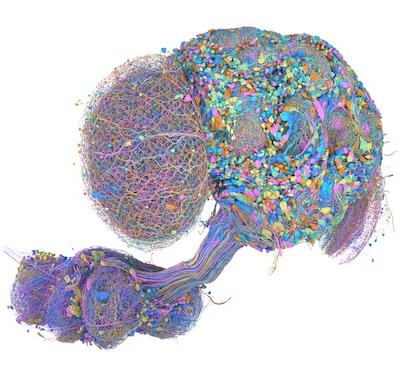
An R wrapper that gives natverse users convenient access to Janelia FlyEM's whole male central nervous system connectome (the public male-cns:v1.0 snapshot on neuPrint), including neuron meshes, annotation columns that cross-reference FlyWire and MANC cell types, and transforms between datasets. It grew out of the collaboration between the Janelia FlyEM team and the Cambridge Drosophila Connectomics Group and has been developed since late 2021.
HHMI Janelia FlyEM, Cambridge Connectomics Group, Google Research
Complete connectome of the ventral nerve cord of an adult male fruit fly, the structure that plays the role of a spinal cord and drives most motor behavior. Released in June 2023 (v1.0) and updated to v1.2 in March 2024 by Janelia's FlyEM team with Cambridge and Google Research, it covers about 23,000 neurons with around 10 million presynaptic sites. Three accompanying papers were published in eLife.
 ▶@barrelshifter on X (video poster, 2026-09-12)
ornata (Jessica Paquette, @barrelshifter)
Jessica Paquette's proof-of-concept that pipes Super Mario 64 frames (from a decompiled SM64 build) into a simulated visual system of a ~100k-neuron MaleCNS v1.0 model and reads controller inputs off named descending neurons: DNg100 for movement, a DNa02/DNg13 difference for steering, DNp01/DNp10 bursts for jumping. There is no learning or reward signal, and the README says the fly mostly walks into walls and gets stuck; the author calls it 100% vibe coded. Covered by Gizmodo on 2026-09-08.
Jefferis lab, MRC LMB
A tidyverse-style family of interoperable R packages for importing, visualising, analysing and exporting 3D neuroanatomy, built around the core nat (NeuroAnatomy Toolbox) package that Greg Jefferis's group has maintained on GitHub since 2014. Satellite packages such as neuprintr and fafbseg give R users access to hemibrain and FlyWire/FAFB data. The ecosystem was described by Bates, Jefferis and colleagues in eLife in 2020.
Janelia FlyEM (HHMI)
Janelia's connectome analysis ecosystem: a Neo4j-backed graph database plus the neuPrintExplorer web front end and an HTTP API for querying neurons and synaptic connectivity. It is the official home of the hemibrain, MANC and male CNS datasets from the FlyEM team, and the ecosystem was described in a 2022 Frontiers in Neuroinformatics paper by Plaza et al.
Janelia FlyEM (HHMI)
The official Python client for the neuPrint service, letting you pull neuron metadata, connectivity tables and skeletons from Janelia's connectome databases into pandas without writing Cypher by hand. First published on PyPI in January 2020 and still actively released (0.6.3 in July 2026), it is installable via pip, conda or pixi.
HHMI Janelia FlyEM Project Team with Google Connectomics
Complete wiring diagram of the right optic lobe of an adult male fruit fly, the visual-processing region, produced by Janelia's FlyEM team with Google's connectomics group. It catalogs more than 50,000 neurons in over 700 types, including roughly 16,000 intrinsic and 32,000 connecting neurons, and is served on neuPrint as optic-lobe v1.1 after a 2024 data release. The accompanying paper, a connectome-driven inventory of a complete visual system, was published in Nature in 2025.
 ▶@alright_mark on X (video poster, 2026-09-12)
@alright_mark
A joke-toned video post by @alright_mark presenting a simulated fly-brain system attempting the "ultimate test" of parallel parking a car. Know Your Meme reports roughly 1.5 million views and 16,000 likes for the 2026-09-10 post. The coverage fetched describes only the video and its caption, not the underlying setup or which connectome data, if any, is simulated.
Philip K. Shiu et al.
The reference code for Shiu et al., "A Drosophila computational brain model reveals sensorimotor processing" (Nature, October 2024), a leaky integrate-and-fire model of the whole FlyWire brain implemented in Brian 2. Users activate neurons by FlyWire ID with Poisson input or silence them to mimic optogenetics and read out spike times and rates; both the v630 and v783 connectome releases are supported and Jupyter tutorials are included. Later projects such as Eon Systems' fly-brain build directly on it.
snedea (GitHub user)
A browser-based simulation by GitHub user snedea that runs a leaky integrate-and-fire network of all 139,255 FlyWire FAFB v783 neurons and 2.7 million connections inside a Web Worker, letting visitors poke the fly with food, touch, wind, light and temperature and watch unscripted behaviour emerge from the wiring. It began in March 2026 as a scale-up of heyseth's 302-neuron C. elegans worm-sim and is hosted at flybrain.app.
Apolotary (Bektur Ryskeldiev)
An Ableton Live extension for macOS that turns the 1,045-neuron MaleCNS motor subset (borrowed from DesktopFly's data) into MIDI: simulated flies bounce around a Three.js scene and their collisions, contacts and motor values trigger notes or modulate ambient parameters across five modes, including a Dark Lab mode with a small learnable 70-weight readout. The author is careful to separate the measured circuit from the composed harmony, describing the flies as particles dressed up as flies. Written up on Sonic Field on 2026-09-10.
Zanichelli, Schons, Freeman, Shiu & Arkhipov (arXiv preprint)
An arXiv preprint (q-bio.NC) by Niccolo Zanichelli, Maximilian Schons, Isaak Freeman, Philip Shiu and Anton Arkhipov that re-evaluates whole-brain emulation progress since the 2008 Sandberg and Bostrom roadmap. The report is organized around three capabilities: recording neural dynamics, mapping structure through connectomics, and emulation with embodiment. First posted October 17, 2025, with a third revision on November 5, 2025, under a CC BY 4.0 license.
Virtual Fly Brain consortium (UK institutions incl. MRC HGU)
A long-running UK-funded web atlas that registers neuron images, gene-expression patterns and connectomics onto standard Drosophila brain templates and links them through an anatomy ontology, so anatomy, expression and connectivity can be cross-searched in one place. Supported since 2009, it now indexes over 600,000 3D images and roughly 490,000 neurons with connectivity, spanning hemibrain, FlyWire, FANC and the larval L1EM data. The v2 front end (geppetto-vfb) is an MIT-licensed customisation of the Geppetto platform.
Wikipedia (Wikimedia Foundation)
Community-written encyclopedia article that serves as a one-stop overview of fruit fly connectomics, explaining why Drosophila is used as a model and walking through the major datasets from the 3,016-neuron larval brain to the adult hemibrain, FlyWire, the FANC and MANC nerve cords, and the 2025 whole-CNS BANC and male CNS reconstructions. It also touches on how wiring structure relates to behavior. Text is under CC BY-SA 4.0; last edited August 11, 2026.
 Fly Brain Hub