 Fly Brain Hub
BANC (Brain And Nerve Cord)
Harvard Medical School (Lee & Wilson labs), Princeton University (Murthy lab), Harvard (Drugowitsch lab)
Connectome of a single adult female fruit fly imaged at 4 nm by serial-section EM, covering her brain and ventral nerve cord together at synapse resolution, which no earlier dataset had managed in one animal. The README reports about 188,000 neurons and 199 million predicted synapses; the analysis code (mostly R) and the Dataverse data are both released under CC BY 4.0. The paper by Bates, Phelps, Kim, Yang and colleagues was published open access in Nature in 2026.
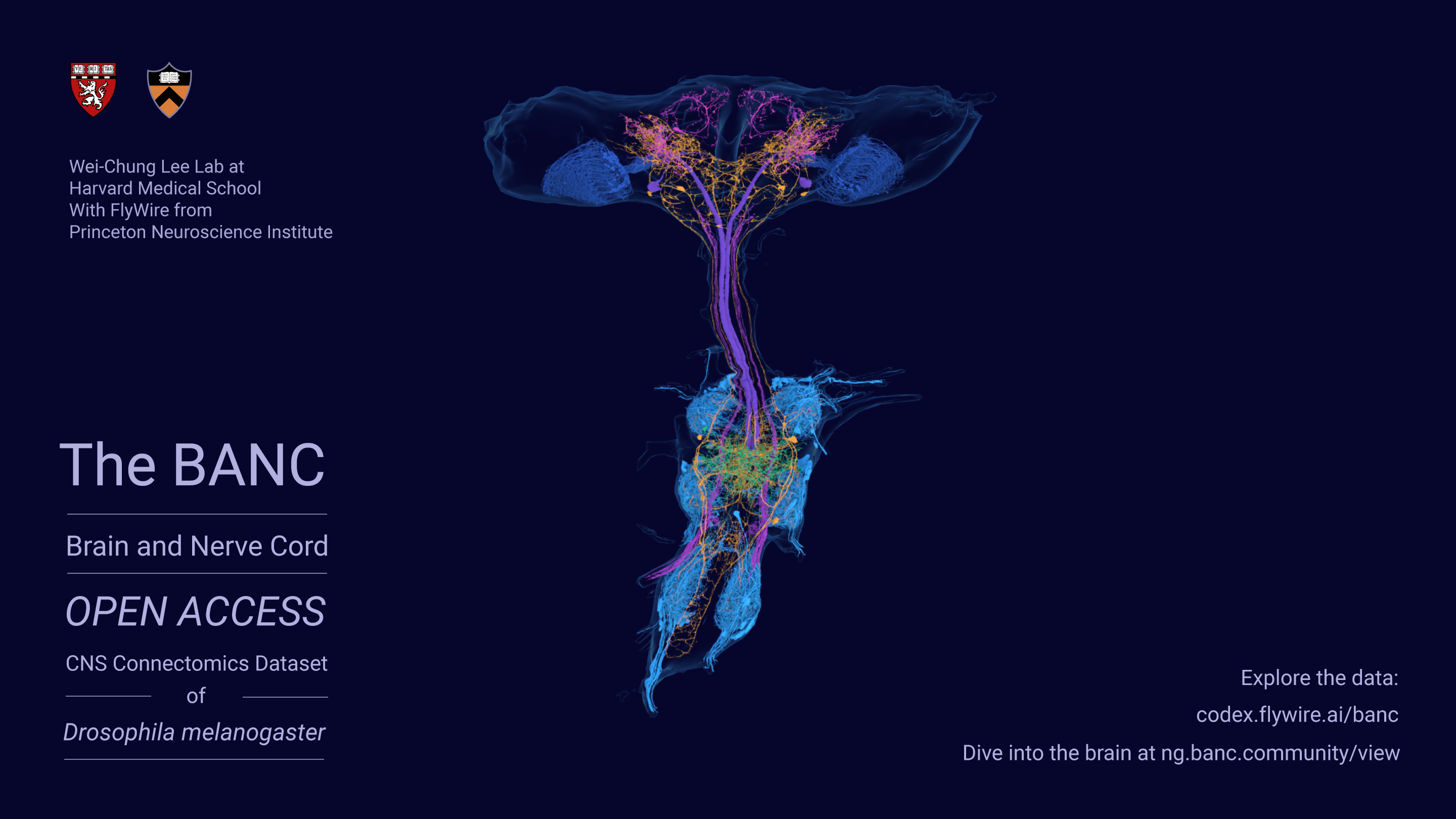 htem/BANC-project README (CC BY 4.0)
Sources checked
Every fact above was read from these pages on the date the entry was added.
- github.com https://github.com/htem/BANC-project
- raw.githubusercontent.com https://raw.githubusercontent.com/htem/BANC-project/main/README.md
- codex.flywire.ai https://codex.flywire.ai/
Used by: 22 projects
flyconn
@moiz-lakkadkutta
A Python toolkit that puts MaleCNS v1.0, FlyWire v630 and v783, hemibrain, MANC and BANC behind one offline, checksummed data layer, then builds signed sparse graphs on top of it. It propagates uncertainty (path stability across weight thresholds), runs a cross-platform LIF simulator validated against published results, and drives experiments from YAML specs that emit reports with provenance and dataset citations. Controls run by default. The README calls the project pre-alpha and is explicit that neurotransmitter identities are predicted and every simulation output is a model prediction.
FlyGym + BANC v888 bridge
@ArisLiWind
A fork of NeLy-EPFL's FlyGym that wires the BANC v888 connectome into the walking controller, which is rare: most embodied projects use FlyWire or MaleCNS. A descending neuron such as DNpe053 is simulated with its local circuit, and its firing rate scales the tripod pattern generator's amplitude. A second script closes the loop at every 0.1 ms physics step: joint angles drive 18 leg sensory neurons, an LIF network of 50 BANC neurons updates online with STDP, and motor-pool spikes become per-leg gains. A bundled script checks overlap coverage and self-loops.
cerebro (cerebro-mosca)
Allan Matheus Silva Santos
An audit of the published whole-brain fly model, not another demo. A numba rewrite reproduces Brian2 spike for spike (rate correlation 0.999) about 1000x faster, which makes the checks affordable: one mislabelled neuron, the left il3LN6, turns an inhibitory cell excitatory and inflates the sugar response from 377 to 8,323 neurons, and an odour lights 66% of Kenyon cells where the fly uses 5-10%. FlyWire and BANC agree only up to rho 0.32 across flies, and BANC's own neurotransmitter consensus contradicts its neurons in 68 cell types. All three were reported upstream.
FLIEGE
IT-EXPRESS Bayern
German open research on the steps between a wiring diagram and behaviour, publishing its counter-findings alongside its results. It ships connectome audits (neuron and synapse counts, differences between synapse detectors, prioritised candidates to re-check), cell identities mapped to senses and body targets with sources and versions, a recomputation of a published central-pattern-generator model under eight control conditions, and browser labs for the body, leg joints, neuron skeletons and a wing roll rig. One closes a foreleg joint loop through a selected BANC subgraph.
FlyArena
NKprime (primaryNK)
A Windows combat sandbox that computes two independent neural states from the BANC v888/v3 connectome — 188,508 neurons and 13,620,865 directed pairs — on Direct3D 12 at a 1 ms step, and lets their output drive sword, shield and movement actuators. There is no scripted attack or parry: hits, blocks, parries and dodges come from geometry and timing, and the learner only touches a small motor readout, never the BANC pairs. The author says it was built with heavy AI assistance, and ships source only for now because the unsigned binary trips a Defender detection they believe is a false positive.
NeuroFly
NeuroFly (neuroflyapp)
A Windows desktop fly whose behaviour falls out of a leaky integrate-and-fire model over measured wiring: 7,270 FlyWire FAFB v783 neurons with 784,219 signed connections for escape, steering, thermosensation, taste and antennal grooming, plus 1,045 MaleCNS v1.0 nerve-cord neurons for walking. The loop runs at 120 Hz with 1 ms neural steps and every action comes with its causal chain. Populations and cell types can be silenced or activated, and ten protocols from the literature rerun from a seed. A validation file lists the benchmarks the model fails and the claims the authors withdrew.
BioReservoir
IG Digital Lab (igdigitallab)
A lab harness that treats each published connectome as a fixed reservoir: load the wiring, run it as a spiking network, drive it with human-world input and read the response out without training the brain. The method is the point. Every run is pre-registered with hashed questions and seeds before the outcome is known, and every brain is scored against three controls: a rewired version of the same graph, a no-brain baseline and a coin flip. It ships the loaders, the LIF core, the scoring and the tests; the first experiment pairs a male and a female fly brain and is still at design stage.
Droso
SebSilent
An autonomous agent whose decision core is a structural carve of the BANC v888 brain-and-nerve-cord connectome: 12,867 neurons and 173,294 signed synapses from the published tables, out of a reconstruction of roughly 188,000. Text is hashed into a 16-of-3,840 sparse code over Kenyon cells, activity propagates for ten sub-steps, and 85 MBONs vote winner-take-all across 12 action pools. Only the 2,983 Kenyon-cell-to-MBON synapses learn, under a three-factor dopamine rule. A degree-matched random control graph can be built, so claims about the wiring can be tested against a scrambled brain.
fly-voca
Injae Yun (@Injae-Yun)
Tries to read a fly's internal states off FlyWire FAFB v783 and BANC v888 wiring, along eight axes including hunger, thirst, arousal, courtship, defence, taste and steering, and records why those states do not persist in simulation. State cells return to baseline within 250 ms after the stimulus ends, which the author notes matches recordings rather than contradicting them; persistence is carried downstream, and three routes (loop gain, a whole-brain scan, a body loop) fail to produce it in this model class. Conditions are seed-matched and refutations are kept as results.
connectome-kit
aujurd22
An analysis toolkit for large connectomes, built and validated on the whole central nervous system female dataset of roughly 170,000 neurons and 13.6 million deduplicated directed connections. Modules cover loading, degree-preserving null models, sampled directed-ring enrichment, spectral gap and modular structure, neurotransmitter-stratified topology, effective information, and phase synchronisation on a graphics card. Every module ships matched random controls, and the loader accepts any edge list, so the dataset-specific wrapper is a convenience rather than a requirement.
Муха в машине (fly-brain-explainer)
cosmiksoul
A Russian interactive explainer that separates the biology, the engineering and the meme in the viral clips. It starts with how a sliced brain becomes a graph and what the graph does not contain, moves through what the spiking simulations actually animate, and ends in a sandbox where a toy fly brain pulls a slot-machine lever and plays a guessing game against the reader. Both games carry a shuffle-the-wiring button, which the author names as the control the viral videos are missing and the thing that separates the brain having learned from the rig having been built that way.
flybench (opifor)
opifor
An independent reimplementation of the Shiu et al. leaky integrate-and-fire model, built to put a male and a female brain in the same simulator and the same world: MaleCNS, the FlyWire FAFB female and the BANC female all load from their public releases. It reproduces the published female benchmarks, and every experiment is pre-registered, with the text hashed into the record and failures reported like successes. Held so far: the male song command chain, and mated-state gating silencing pC1 and vpoDN. Not held: song entering the female ear never reaches vpoDN.
Virtual Fly (Project Genesis)
ritwikj2
A creature that keeps living in a 3D jar whether or not anyone is watching, driven by 143,921 neurons and 12.3 million synapses from the BANC connectome as spiking neurons. It receives only a 12 by 6 pixel image, two antennal odour concentrations, per-leg touch, joint angles, heat, hunger and pain, with no language model and no if-hungry-go-to-food rule anywhere. State is checkpointed every two minutes and resumes after a restart. Its log reports 55 simulated hours across 19 lives, with hazard avoidance rising from roughly half to about 80 percent of approaches.
BrainLab
@Pronexsteam
A single-GPU LIF simulator that marks every run pass or fail against an outside reference. The interesting result is negative: the sugar-to-MN9 taste experiment from Shiu et al. 2024, run on three adult connectomes, gives 76.7 Hz on FAFB v783, 68.9 Hz on MaleCNS v0.9 and 17.8 Hz on BANC v888. A control rules out edge thresholding, since FAFB at threshold 1 still reaches 70.0 Hz, pointing at the raw synapse counts instead - so the spread says more about the three datasets than about the fly. Its own FAFB figure of 111 Hz also sits above the published 93.27 Hz.
VFB Self-Led Learning (NeuroFly 2026)
Virtual Fly Brain team
Virtual Fly Brain reopened the hands-on workshop it built for NeuroFly 2026 as seven self-led sessions anyone can work through for free, announced on the VFB news page on 6 September 2026. They run from finding a neuron, through bridging between datasets, to pulling in single-cell transcriptomics, and each can be done five ways: the vfb_connect Python client, natverse in R via reticulate, a natural-language chat, an MCP endpoint for driving it from an LLM, or the 3D browser. Material covers BANC, male CNS, MANC and the optic lobe. The footer states GPL v2.
Fruit-fly CNS - live connectome driving a body
@wjb000
A browser page where roughly 166,000 traced male CNS neurons run as leaky integrate-and-fire units with short-term depression, and the motor-neuron pools alone move the body, which goes limp when they fall quiet; the page defaults to a quadrotor, with the NeuroMechFly model behind a query parameter. What sets it apart from the other embodied demos is the perturbation kit: silence, boost, cut, swap, delay or hunger-gate any neuron from the console, run lesion sweeps, and try a cross-sex graph transplant against BANC in the repo tooling. That transplant is reported as a failure twice over.
connectome_interpreter
Yijie Yin, University of Cambridge
A Python library that turns a wiring diagram into testable hypotheses about circuit function, and it runs on a laptop or in Colab even for whole-brain analyses of around 140,000 neurons. It computes polysynaptic effective connectivity between groups of neurons with or without signs, retrieves and plots the actual subcircuit between sources and targets, and exposes a differentiable connectome model. Installable from PyPI, with an accompanying preprint and Colab notebook.
coconatfly
Gregory Jefferis (natverse)
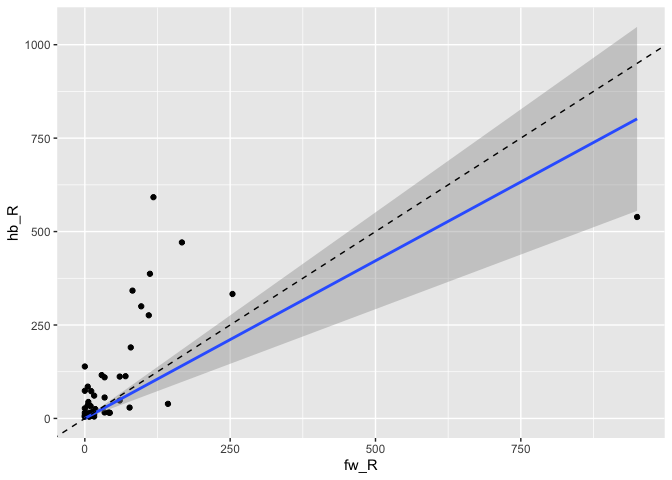
An R package from Greg Jefferis that puts one uniform interface over the major fly connectomes so the same partner-query or cell-type comparison can be run across hemibrain, FlyWire, MANC, FANC, BANC, the male CNS and the male optic lobe. It is flagged as experimental and its API may still change, but it is already the workhorse for hemibrain-versus-FlyWire comparisons in the natverse community.
connectome_data_prep
Yijie Yin, University of Cambridge
Yijie Yin's (Cambridge) notebooks and scripts for turning raw connectome releases into analysis-ready sparse connectivity matrices and metadata tables, with axon/dendrite splitting via flow centrality. It covers the adult male CNS, BANC, FlyWire/FAFB, hemibrain and MANC as well as the larval connectome, and includes benchmarking code for the pathfinding and effective-connectivity analyses used in the Connectome Interpreter framework. No license file is present.
Fly Connectome Data Tutorial (SJCABS)
SJCABS winter school (Sven Dorkenwald & Alexander Bates)
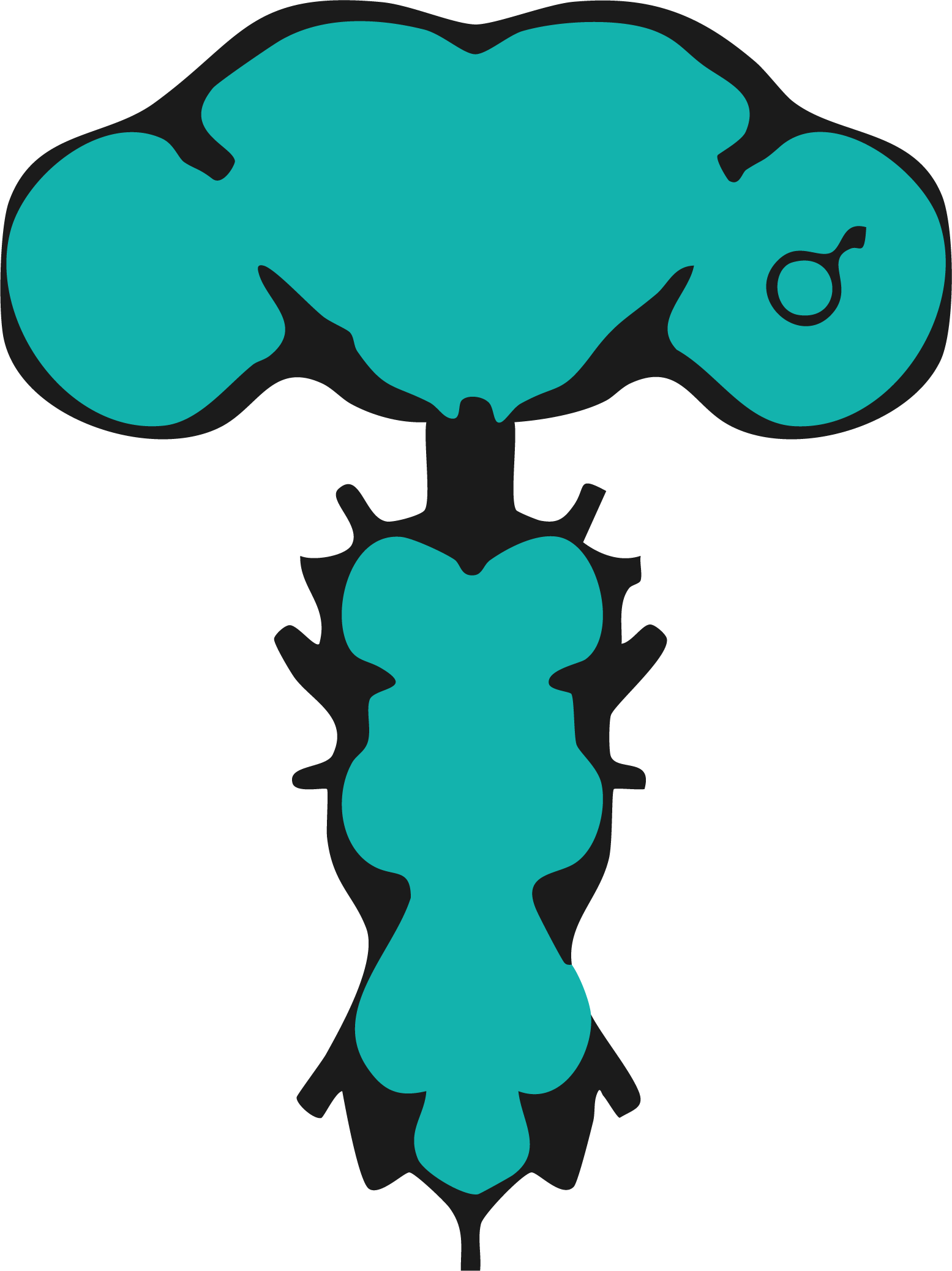
Course material from the San Juan Winter School on Connectomics and Brain Simulation, written by Sven Dorkenwald and Alexander Bates, that walks students from loading data to morphology, direct and indirect connectivity analysis in both Python and R. Its most useful feature is a harmonised metadata schema and a public cloud bucket covering BANC, FAFB, the male CNS, MANC and hemibrain, so the same notebooks run across all five datasets.
FlyWire Codex
Princeton Neuroscience Institute
A browser-based explorer developed at the Princeton Neuroscience Institute that lets anyone search, filter and visualise large connectomes entirely in the browser, with no local install or bulk download. Beyond FlyWire's own FAFB v783 (139,255 neurons) it now serves BANC v888, Janelia's MANC v1.2.1, the male optic lobe (MAOL v1.1) and the male CNS v1.0, and had passed 60,000 registered users by early 2026. The open-source code lives in the murthylab/codex repository under Apache-2.0.
Wikipedia: Drosophila connectome
Wikipedia (Wikimedia Foundation)
Community-written encyclopedia article that serves as a one-stop overview of fruit fly connectomics, explaining why Drosophila is used as a model and walking through the major datasets from the 3,016-neuron larval brain to the adult hemibrain, FlyWire, the FANC and MANC nerve cords, and the 2025 whole-CNS BANC and male CNS reconstructions. It also touches on how wiring structure relates to behavior. Text is under CC BY-SA 4.0; last edited August 11, 2026.