 Fly Brain Hub
MANC (Male Adult Nerve Cord)
HHMI Janelia FlyEM, Cambridge Connectomics Group, Google Research
Complete connectome of the ventral nerve cord of an adult male fruit fly, the structure that plays the role of a spinal cord and drives most motor behavior. Released in June 2023 (v1.0) and updated to v1.2 in March 2024 by Janelia's FlyEM team with Cambridge and Google Research, it covers about 23,000 neurons with around 10 million presynaptic sites. Three accompanying papers were published in eLife.
Sources checked
Every fact above was read from these pages on the date the entry was added.
- janelia.org https://www.janelia.org/project-team/flyem/manc-connectome
Used by: 17 projects
fly-connectome-wiring
Guan et al. (HKUST)
Fixed-weight rate models of the adult fly leg motor system, built from MaleCNS v1.0 and MANC v1.0 and compared with six families of rewired networks under criteria fixed before the runs. It also runs the motor-input reassignment, rescue, capped-reassignment and sign-perturbation experiments. The manuscript build recomputes every reported number from the data and fails on any mismatch; noise streams are seeded, so a confirmation run reproduces the archived window to within 1e-16. Neither connectome is redistributed: you supply the public flat files.
flyconn
@moiz-lakkadkutta
A Python toolkit that puts MaleCNS v1.0, FlyWire v630 and v783, hemibrain, MANC and BANC behind one offline, checksummed data layer, then builds signed sparse graphs on top of it. It propagates uncertainty (path stability across weight thresholds), runs a cross-platform LIF simulator validated against published results, and drives experiments from YAML specs that emit reports with provenance and dataset citations. Controls run by default. The README calls the project pre-alpha and is explicit that neurotransmitter identities are predicted and every simulation output is a model prediction.
Insectome (Bug Connectome Project)
theworker02
A local studio over several insect connectome packs — neuPrint hemibrain, MANC and optic lobe, plus Insect Brain Database projectomes — browsed by silhouette and cell class rather than by lists of IDs. It reuses published level-0 and level-1 graphs instead of re-segmenting electron microscopy, keeps raw EM remote, and holds the local cache to a 10 GB ceiling; the shareable Pages build ships about 23 MB of catalogs against a 1.7 GB local pack footprint. Its stated rules include never merging the packs into an invented single insectome and never claiming synaptic connectivity without evidence.
fly-cord-robots
SakshayMahna
Drives a simulated legged robot from the fly's ventral nerve cord, its spinal-cord equivalent, instead of a hand-designed gait, first on a hexapod, then on an amputated quadruped it never evolved for. The log is the interesting part: the published circuit science was reproduced, all six leg circuits identified and confirmed, a fly body built in physics simulation, and motor-neuron output moved real joints open loop. Then a pre-registered pilot closed the loop with proprioceptive feedback and found it either negligible or enough to drive the network into a runaway, non-rhythmic state.
cocoa
flyconnectome
A Python library for comparing and jointly clustering neurons across connectomes, including FlyWire, hemibrain, MANC and MaleCNS. It helps investigate cell-type correspondence across different reconstructions. The documented FANC and BANC integrations remain TODO items and are not counted as implemented support here.
Drosophila MANC Connectome Synthesizer
Benn Jordan (@bennjordan)
A browser instrument that plays the male fly's courtship song from the MANC nerve-cord connectome instead of samples. P1 integrates proximity and contact, pIP10 and pPR1 gate pulse and sine song, and a vPR6 and GABAergic loop in neuromere T2 sets the roughly 35 ms inter-pulse interval, driving MN-b1 and MN-b2. The Web Audio side models the wing pushing into air: drive rises from 0.8x to 3.2x between 2 mm and 25 mm, contact adds up to plus or minus 105 Hz of jitter, and a thoracic resonator sweeps its Q. Slowpoke mutants and sibling species are included.
VFB Self-Led Learning (NeuroFly 2026)
Virtual Fly Brain team
Virtual Fly Brain reopened the hands-on workshop it built for NeuroFly 2026 as seven self-led sessions anyone can work through for free, announced on the VFB news page on 6 September 2026. They run from finding a neuron, through bridging between datasets, to pulling in single-cell transcriptomics, and each can be done five ways: the vfb_connect Python client, natverse in R via reticulate, a natural-language chat, an MCP endpoint for driving it from an LLM, or the 3D browser. Material covers BANC, male CNS, MANC and the optic lobe. The footer states GPL v2.
connectome_interpreter
Yijie Yin, University of Cambridge
A Python library that turns a wiring diagram into testable hypotheses about circuit function, and it runs on a laptop or in Colab even for whole-brain analyses of around 140,000 neurons. It computes polysynaptic effective connectivity between groups of neurons with or without signs, retrieves and plots the actual subcircuit between sources and targets, and exposes a differentiable connectome model. Installable from PyPI, with an accompanying preprint and Colab notebook.
webgpu-fly
Ahmet Barış Günaydın (@abgnydn)
Fire a real descending neuron in the FlyWire connectome and watch the spike cascade propagate through the wiring into MANC nerve-cord data; what comes out is a walking magnitude and a turn bias that modulate a hand-written tripod gait. It runs entirely in the browser on WebGPU with no install, and ships a separate science view. The README labels the motor mappings as explicit approximations, and the project predates the September 2026 wave by several months.
coconatfly
Gregory Jefferis (natverse)
An R package from Greg Jefferis that puts one uniform interface over the major fly connectomes so the same partner-query or cell-type comparison can be run across hemibrain, FlyWire, MANC, FANC, BANC, the male CNS and the male optic lobe. It is flagged as experimental and its API may still change, but it is already the workhorse for hemibrain-versus-FlyWire comparisons in the natverse community.
connectome_data_prep
Yijie Yin, University of Cambridge
Yijie Yin's (Cambridge) notebooks and scripts for turning raw connectome releases into analysis-ready sparse connectivity matrices and metadata tables, with axon/dendrite splitting via flow centrality. It covers the adult male CNS, BANC, FlyWire/FAFB, hemibrain and MANC as well as the larval connectome, and includes benchmarking code for the pathfinding and effective-connectivity analyses used in the Connectome Interpreter framework. No license file is present.
Fly Connectome Data Tutorial (SJCABS)
SJCABS winter school (Sven Dorkenwald & Alexander Bates)
Course material from the San Juan Winter School on Connectomics and Brain Simulation, written by Sven Dorkenwald and Alexander Bates, that walks students from loading data to morphology, direct and indirect connectivity analysis in both Python and R. Its most useful feature is a harmonised metadata schema and a public cloud bucket covering BANC, FAFB, the male CNS, MANC and hemibrain, so the same notebooks run across all five datasets.
FlyWire Codex
Princeton Neuroscience Institute
A browser-based explorer developed at the Princeton Neuroscience Institute that lets anyone search, filter and visualise large connectomes entirely in the browser, with no local install or bulk download. Beyond FlyWire's own FAFB v783 (139,255 neurons) it now serves BANC v888, Janelia's MANC v1.2.1, the male optic lobe (MAOL v1.1) and the male CNS v1.0, and had passed 60,000 registered users by early 2026. The open-source code lives in the murthylab/codex repository under Apache-2.0.
malecns (R)
natverse / Jefferis lab with Janelia FlyEM
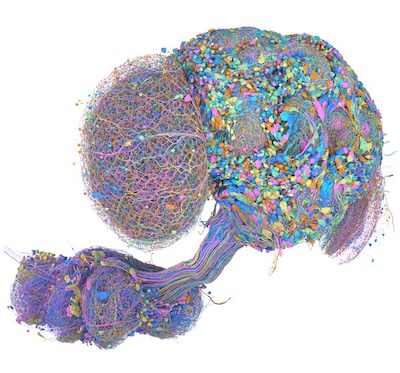
An R wrapper that gives natverse users convenient access to Janelia FlyEM's whole male central nervous system connectome (the public male-cns:v1.0 snapshot on neuPrint), including neuron meshes, annotation columns that cross-reference FlyWire and MANC cell types, and transforms between datasets. It grew out of the collaboration between the Janelia FlyEM team and the Cambridge Drosophila Connectomics Group and has been developed since late 2021.
neuPrint
Janelia FlyEM (HHMI)
Janelia's connectome analysis ecosystem: a Neo4j-backed graph database plus the neuPrintExplorer web front end and an HTTP API for querying neurons and synaptic connectivity. It is the official home of the hemibrain, MANC and male CNS datasets from the FlyEM team, and the ecosystem was described in a 2022 Frontiers in Neuroinformatics paper by Plaza et al.
neuprint-python
Janelia FlyEM (HHMI)
The official Python client for the neuPrint service, letting you pull neuron metadata, connectivity tables and skeletons from Janelia's connectome databases into pandas without writing Cypher by hand. First published on PyPI in January 2020 and still actively released (0.6.3 in July 2026), it is installable via pip, conda or pixi.
Wikipedia: Drosophila connectome
Wikipedia (Wikimedia Foundation)
Community-written encyclopedia article that serves as a one-stop overview of fruit fly connectomics, explaining why Drosophila is used as a model and walking through the major datasets from the 3,016-neuron larval brain to the adult hemibrain, FlyWire, the FANC and MANC nerve cords, and the 2025 whole-CNS BANC and male CNS reconstructions. It also touches on how wiring structure relates to behavior. Text is under CC BY-SA 4.0; last edited August 11, 2026.