brandoncho369
A reflex benchmark that asks the question the demo wave mostly skips: does the simulated fly still do the things a real fly is known to do? It ships a suite of behavioural tasks with literature citations, a reference leaky integrate-and-fire simulator and a scoring harness, so any set of model parameters gets a comparable number. The framing is direct about why it exists, that every Minecraft or Doom demo had to guess at synaptic weight, global gain and inhibition and then hand-tune until something looked alive.
Evan Sinclair Smith (@evnsnclr), Georgia Institute of Technology
A Minecraft fly driven by the full retained MaleCNS graph: 166,700 neurons and 25,582,938 directed edges, with six declared in-game inputs (player approach, nearby mobs, brushing, attack attempts, food, light) feeding the model and hand-chosen readouts selecting scripted body programs. The repository is currently a landing page and roadmap: the recorded demo exists, but the Fabric mod and companion source have not been published yet. The README is explicit that this shows a visible, testable mapping, not recovered fly physiology.
 htem/BANC-project README (CC BY 4.0)
Harvard Medical School (Lee & Wilson labs), Princeton University (Murthy lab), Harvard (Drugowitsch lab)
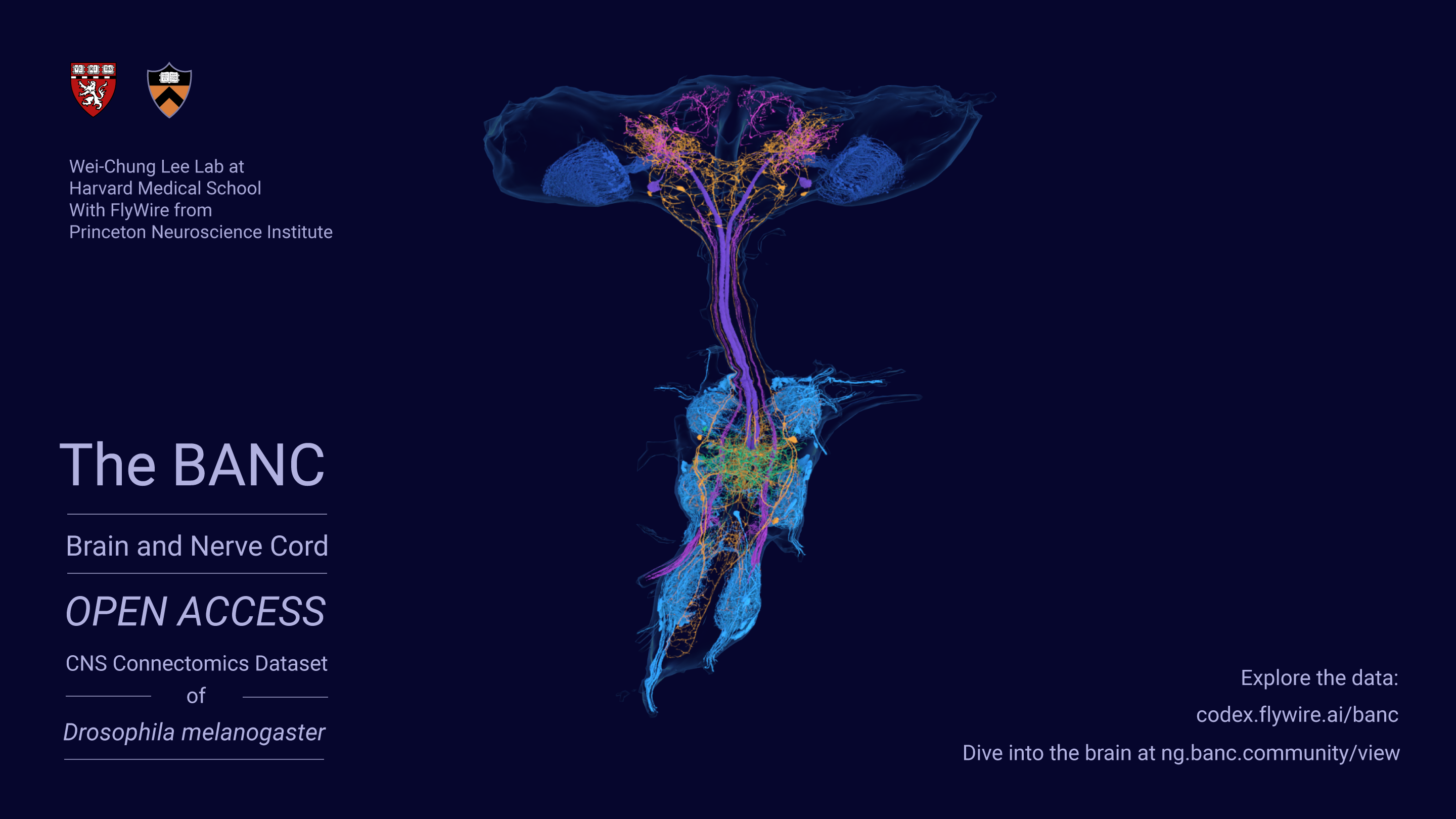
Connectome of a single adult female fruit fly imaged at 4 nm by serial-section EM, covering her brain and ventral nerve cord together at synapse resolution, which no earlier dataset had managed in one animal. The README reports about 188,000 neurons and 199 million predicted synapses; the analysis code (mostly R) and the Dataverse data are both released under CC BY 4.0. The paper by Bates, Phelps, Kim, Yang and colleagues was published open access in Nature in 2026.
 DenisSergeevitch/desktop-fly README (MIT)
DenisSergeevitch
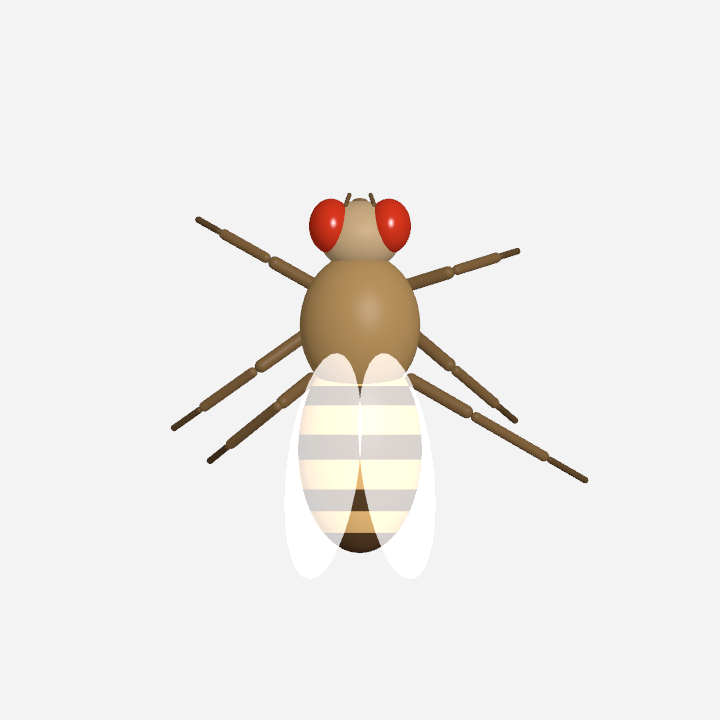
A 3D fruit fly living on the macOS desktop (Electron port for Windows), driven by a 1 kHz leaky integrate-and-fire simulation of two real circuits: a 668-neuron FlyWire subset for sensing, escape and decisions, and a 1,045-neuron MaleCNS descending-to-leg pathway ending in 220 motor neurons. Window edges act as terrain, window moves as threats and clicks as vibrations, and a separate window shows 23,210 neuron positions spiking live. The README is upfront that muscle mechanics are modeled rather than biologically calibrated; code is MIT, FlyWire data CC BY-NC 4.0 and MaleCNS CC BY 4.0.
nftechie (Alex Wormuth)
A MaleCNS v1.0 spiking simulation wired to a live Doom arena: each frame stimulates visual input neurons, activity propagates through 166,700 neurons, and motor output is decoded into movement and firing. The README is candid that learned survival has not been demonstrated yet.
Eon Systems PBC
Eon Systems' open re-implementation of the Shiu et al. (Nature 2024) leaky integrate-and-fire whole-brain model, covering roughly 138,000 FlyWire v783 neurons and 5 million synapses and runnable on Brian2 (CPU/CUDA), PyTorch, NEST GPU and GeNN backends so users can stimulate or silence any population and watch activity propagate. In a March 10, 2026 update the company reported coupling this brain to a NeuroMechFly v2 body in MuJoCo, describing grooming, feeding and foraging behaviours emerging from the closed sensorimotor loop, which it calls the first embodied fly upload.
 blendi-remade/fly-brain-minecraft README screenshot (MIT)
blendi-remade
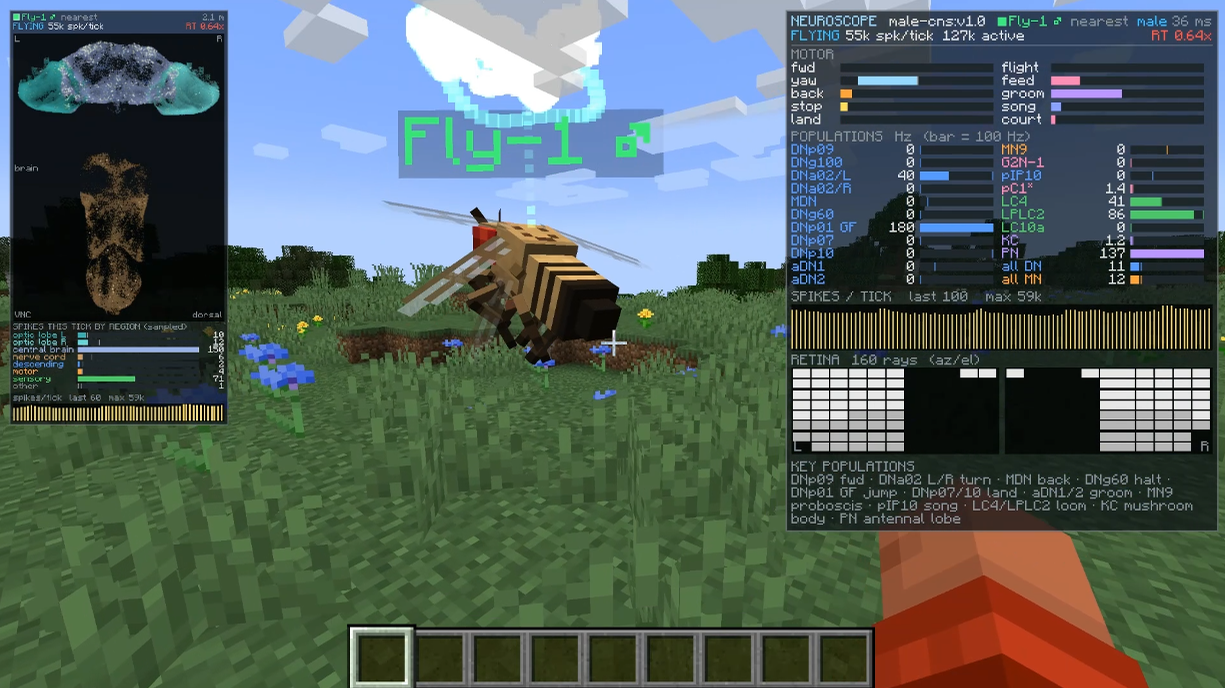
A Fabric mod for Minecraft 1.21.1 that runs the full neuPrint male-cns v1.0 connectome (about 176k neurons, 6.29M connections at 5+ synapses) as leaky integrate-and-fire units inside a fly mob, one thread per fly. In-game visual, smell, taste and touch stimuli feed sensory neurons, and decoded motor channels drive feeding, grooming, escape jumps, walking and flight. Includes a live brain-activity view, a HUD of population firing rates, and 56 JUnit tests; code is MIT, connectome data CC BY 4.0.
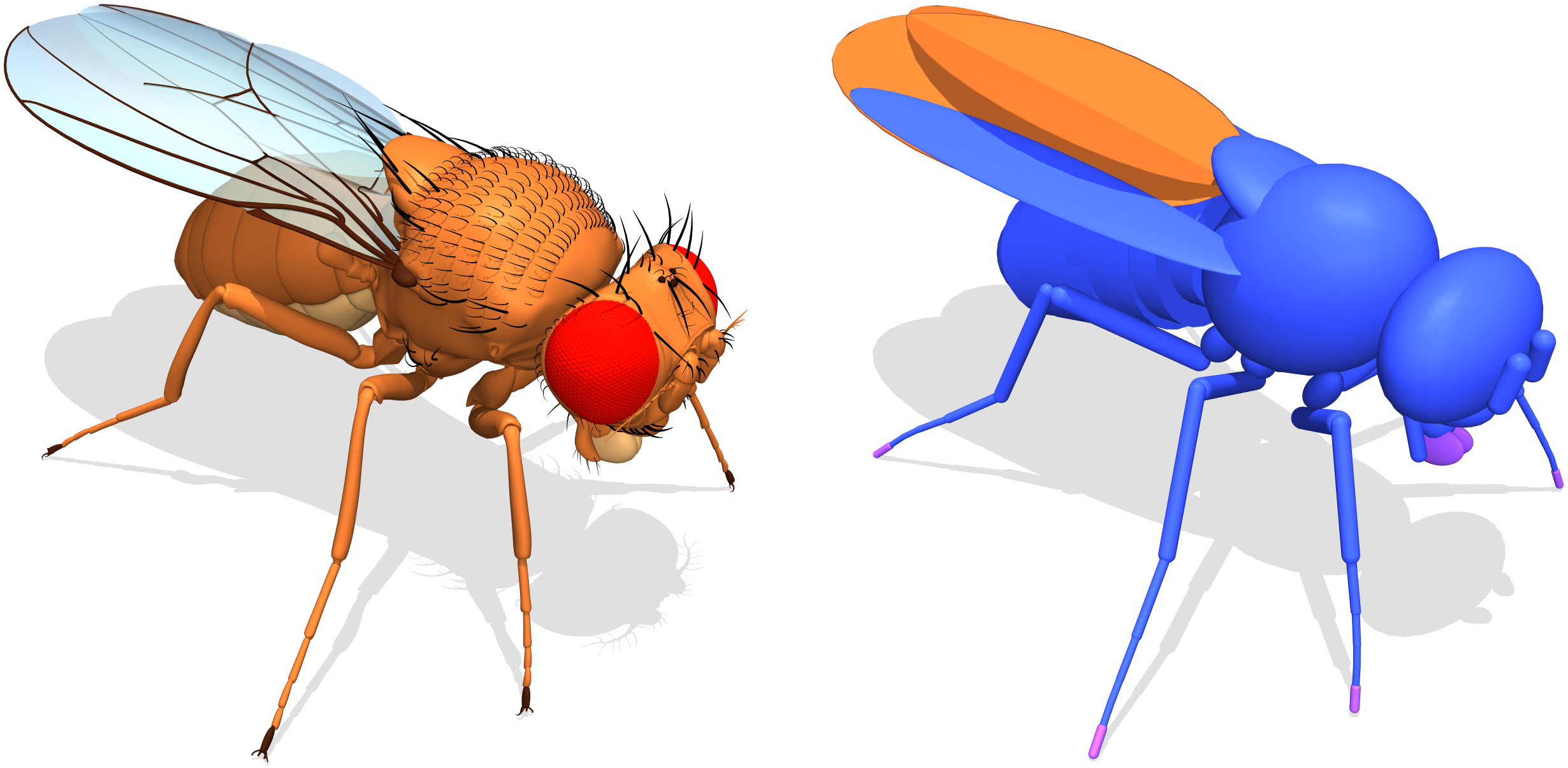 TuragaLab/flybody README (Apache-2.0)
Google DeepMind / HHMI Janelia (Turaga Lab)
An anatomically detailed fruit-fly body for the MuJoCo physics engine, with articulated legs, wings, leg adhesion and ready-made reinforcement learning tasks for walking imitation, free flight and vision-guided flight. Published in Nature in 2025 and released under Apache-2.0.
Princeton University (Murthy & Seung labs) with the FlyWire consortium
Whole-brain connectome of an adult female fruit fly, built by AI segmentation of the FAFB electron-microscopy volume followed by community proofreading led from Princeton. Version 783, served through the Codex explorer, holds 139,255 proofread neurons and tens of millions of synapses with neurotransmitter predictions. The flagship paper (Dorkenwald et al.) appeared in Nature in 2024 alongside companion annotation papers.
University of Cambridge (Michael Winding et al.)
Complete synaptic wiring diagram of an entire insect brain, reconstructed from a first-instar Drosophila larva and published in Science in March 2023 by a team led by Michael Winding (University of Cambridge). It comprises 3,016 neurons and about 548,000 synapses, and the analysis highlighted heavy multisensory integration, interhemispheric crosstalk and recurrent circuit motifs.
HHMI Janelia FlyEM / University of Cambridge / MRC LMB / Google Research
The first complete wiring diagram of an adult male fruit fly's whole central nervous system: brain, optic lobes and ventral nerve cord in one volume, with more than 166,000 neurons. Released as open data under CC-BY, it is the dataset behind the September 2026 wave of fly-brain demos.
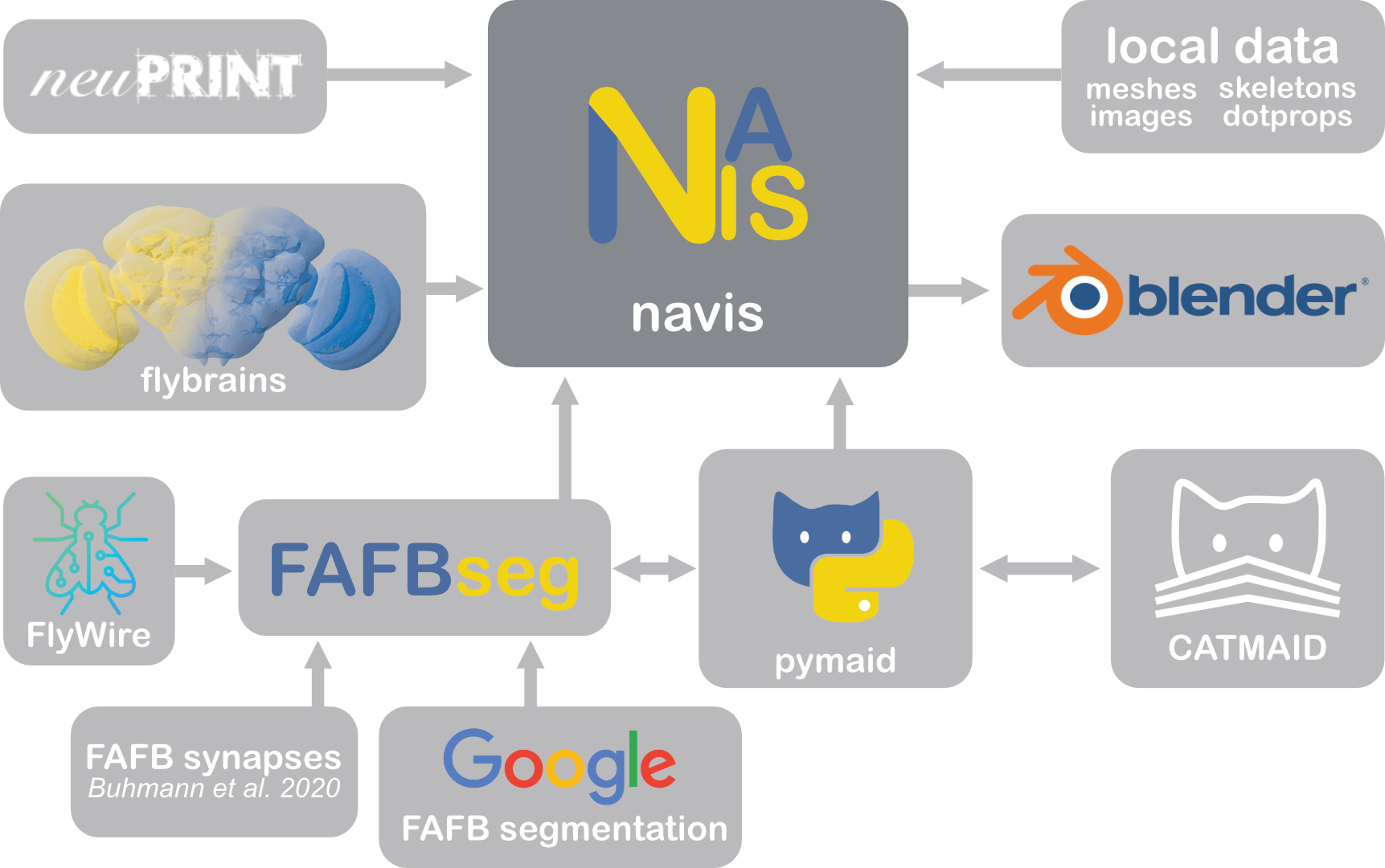 navis-org/navis docs (GPL-3.0)
navis-org (Fly Connectomics group, Cambridge)
A general-purpose Python library for handling neuron skeletons, meshes, dotprops and image volumes, with 2D/3D plotting, morphometrics, NBLAST similarity and template-brain transforms built in. Developed in the Cambridge fly connectomics community as the Python counterpart of the R natverse, it plugs into neuPrint and, through the fafbseg extension, FlyWire/FAFB. Performance-critical pieces have been moved to Rust via navis-fastcore.
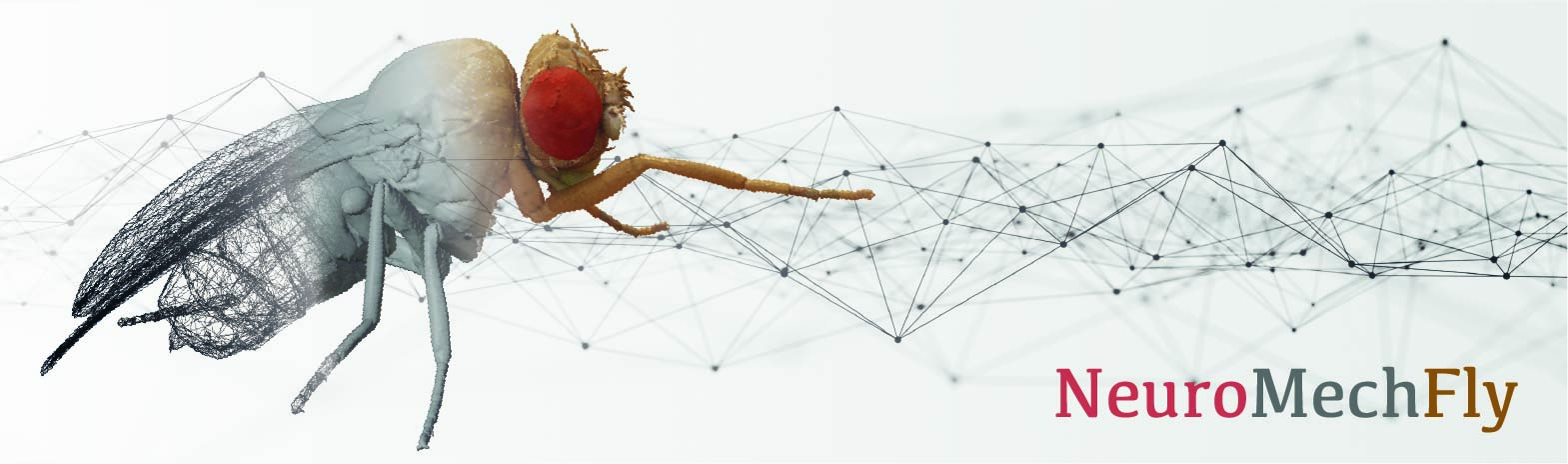 NeLy-EPFL/flygym README banner (Apache-2.0)
Neuroengineering Laboratory (NeLy), EPFL
EPFL's digital twin of the adult fruit fly: a micro-CT-derived biomechanical body simulated in MuJoCo with compound-eye vision, olfaction, leg adhesion, mechanosensory feedback and a hierarchical brain/VNC control architecture. NeuroMechFly v2 was published in Nature Methods in November 2024 (Wang-Chen, Ramdya et al.), and the FlyGym 2.0 rewrite released in April 2026 brought roughly 10x faster CPU simulation and about 300x faster GPU simulation via Warp/MJWarp. It is the body used by the Eon and Rojas embodied whole-brain projects.
 Fly Brain Hub