 Fly Brain Hub
FlyWire (FAFB v783)
Princeton University (Murthy & Seung labs) with the FlyWire consortium
Whole-brain connectome of an adult female fruit fly, built by AI segmentation of the FAFB electron-microscopy volume followed by community proofreading led from Princeton. Version 783, served through the Codex explorer, holds 139,255 proofread neurons and tens of millions of synapses with neurotransmitter predictions. The flagship paper (Dorkenwald et al.) appeared in Nature in 2024 alongside companion annotation papers.
Sources checked
Every fact above was read from these pages on the date the entry was added.
- flywire.ai https://flywire.ai/
- codex.flywire.ai https://codex.flywire.ai/
- codex.flywire.ai https://codex.flywire.ai/api/download
- flywire.ai https://flywire.ai/tos
Used by: 25 projects
flybench
brandoncho369
A reflex benchmark that asks the question the demo wave mostly skips: does the simulated fly still do the things a real fly is known to do? It ships a suite of behavioural tasks with literature citations, a reference leaky integrate-and-fire simulator and a scoring harness, so any set of model parameters gets a comparable number. The framing is direct about why it exists, that every Minecraft or Doom demo had to guess at synaptic weight, global gain and inhibition and then hand-tune until something looked alive.
DesktopFly
DenisSergeevitch
A 3D fruit fly living on the macOS desktop (Electron port for Windows), driven by a 1 kHz leaky integrate-and-fire simulation of two real circuits: a 668-neuron FlyWire subset for sensing, escape and decisions, and a 1,045-neuron MaleCNS descending-to-leg pathway ending in 220 motor neurons. Window edges act as terrain, window moves as threats and clicks as vibrations, and a separate window shows 23,210 neuron positions spiking live. The README is upfront that muscle mechanics are modeled rather than biologically calibrated; code is MIT, FlyWire data CC BY-NC 4.0 and MaleCNS CC BY 4.0.
Eon fly-brain
Eon Systems PBC
Eon Systems' open re-implementation of the Shiu et al. (Nature 2024) leaky integrate-and-fire whole-brain model, covering roughly 138,000 FlyWire v783 neurons and 5 million synapses and runnable on Brian2 (CPU/CUDA), PyTorch, NEST GPU and GeNN backends so users can stimulate or silence any population and watch activity propagate. In a March 10, 2026 update the company reported coupling this brain to a NeuroMechFly v2 body in MuJoCo, describing grooming, feeding and foraging behaviours emerging from the closed sensorimotor loop, which it calls the first embodied fly upload.
NAVis
navis-org (Fly Connectomics group, Cambridge)
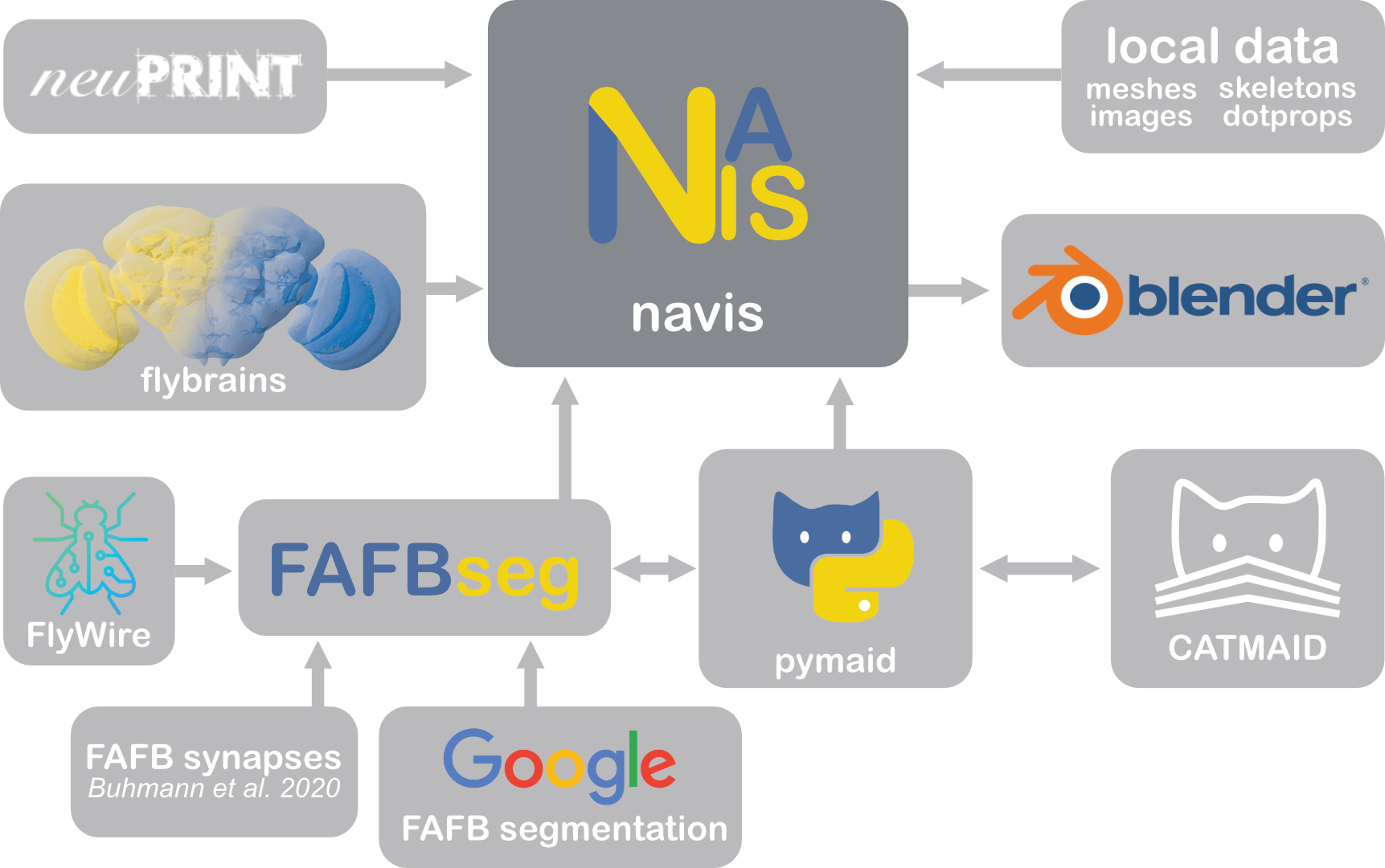
A general-purpose Python library for handling neuron skeletons, meshes, dotprops and image volumes, with 2D/3D plotting, morphometrics, NBLAST similarity and template-brain transforms built in. Developed in the Cambridge fly connectomics community as the Python counterpart of the R natverse, it plugs into neuPrint and, through the fafbseg extension, FlyWire/FAFB. Performance-critical pieces have been moved to Rust via navis-fastcore.
flybrain (annel0)
annel0
A fast GPU simulator for connectome-constrained spiking models of the Drosophila central nervous system, published together with a record of what it could not establish. It started from the question the viral wave skipped, that everyone reads the brain but nobody changes it, and ends by setting out in measured terms why that question cannot yet be answered honestly. MaleCNS v1.0 is imported to a CSR graph and FlyWire 783 exactly, so someone else's published predictions can be replicated; that replication lands at a median ratio of 1.01 and a correlation of 0.970 across thirteen neurons.
FLYBRAIN · Bad Apple × DOOM
fazchile17
A local 3D viewer of the FlyWire FAFB v783 connectome, 139,255 neurons, 15,091,983 directed pairs and 54,492,922 contacts, that paints either the Bad Apple!! animation or the shareware episode of DOOM using nothing but neurons as pixels. After a one-off data preparation of roughly 3 GB the viewer runs entirely offline on localhost; only the outbound links to Virtual Fly Brain and FlyWire need the network. Documentation is in Spanish. One of two independent Bad Apple entries from the same week.
FlyBrain-HalfLife
Yusuftmle
An agent that plays Valve's Half-Life with no deep network, policy or reinforcement learning in the loop: every turn, jump and evasive move comes out of biophysical leaky integrate-and-fire circuits derived from MaleCNS v1.0 and FlyWire and simulated as sparse tensors. Frames are projected onto a 60x60 compound-eye retina and taking damage triggers a giant-fiber escape. The headline figure is the size of the source dataset; the graph actually stepped in the demo is a 12,260-neuron subgraph, shown beside the game with calcium-style activity and descending-neuron meters.
Buzzback Brain
Buzzback (zormy111)
The neuroscience core of a token project: it simulates the complete FlyWire female brain (138,639 neurons, 15,091,983 synaptic rows) as a leaky integrate-and-fire network, stimulates the sugar-sensing gustatory receptor neurons and reads out the proboscis-extension motor neuron MN9, whose firing triggers an on-chain buyback in production. The repository publishes the model, the calibration and a demo video; the code is the interesting part, and this listing covers the code, not the token.
Listed for information only. No endorsement, no referral links.
connectome_interpreter
Yijie Yin, University of Cambridge
A Python library that turns a wiring diagram into testable hypotheses about circuit function, and it runs on a laptop or in Colab even for whole-brain analyses of around 140,000 neurons. It computes polysynaptic effective connectivity between groups of neurons with or without signs, retrieves and plots the actual subcircuit between sources and targets, and exposes a differentiable connectome model. Installable from PyPI, with an accompanying preprint and Colab notebook.
FastFly
eonfathom (Michael)
A GPU simulator aiming at real-time or faster execution of the whole FlyWire brain, 139,255 neurons and 54.5 million synapses, on a single consumer NVIDIA card. The engineering is the point: leaky integrate-and-fire neurons, CSR sparse connectivity with FP16 weights, a push model that only processes synapses of neurons that actually fired, warp-ballot spike detection with bit-packed flags, and warp-per-spike load balancing. Connectivity comes from Shiu et al.'s v783 release and annotations from flywire_annotations.
FlyBrain Engine
Mehran (@mehrantsi)
A native Rust and Metal implementation of the published FlyWire leaky integrate-and-fire model, with Python kept as an independent Brian2/NumPy verification lane and as the offline Parquet-to-CSR compiler. It now carries a Rust embodiment layer too: MuJoCo runs an exported NeuroMechFly body behind a fixed-rate sensory bridge and a native viewer. A separate experimental integration connects MaleCNS v1.0, 166,700 neurons and 24,469,412 signed edges including the nerve cord, adding no cross-specimen wiring. A paired control run disconnects the motor readout while the neurons keep running.
The Fly Wheel (blackjack dealer)
flywheel-sol
A blackjack dealer whose hit-or-stand decision on hands of 12 to 20 comes from one stimulation of a FlyWire v783 leaky integrate-and-fire simulation (138,639 neurons, 15.09 million synapses) with Shiu et al. 2024 parameters, read out at the proboscis motor neuron MN9. The repository ships the model, the measured calibration, a negative control and a script that replays any hand played on the site, so a player can verify which code decided it. Listed for the verifiable-decision machinery, not the token.
Listed for information only. No endorsement, no referral links.
Infinite Sugar
William Kelly (@cnqso)
A browser artwork rather than a game: 139,255 FlyWire neurons drive an embodied fly in a terrarium whose sweet-sensing neurons receive continuous stimulation, so it feeds forever. Feeding, head and antennal motion follow neural activity, while wing movements and small foot shuffles use supplied patterns; a corner map lights up sampled FlyWire positions as neurons fire. The author credits Harris Rosenblum's Infinite Pain (2025) as the inspiration and lists flybody, MuJoCo and Shiu et al. as the body and model references.
webgpu-fly
Ahmet Barış Günaydın (@abgnydn)
Fire a real descending neuron in the FlyWire connectome and watch the spike cascade propagate through the wiring into MANC nerve-cord data; what comes out is a walking magnitude and a turn bias that modulate a hand-written tripod gait. It runs entirely in the browser on WebGPU with no install, and ships a separate science view. The README labels the motor mappings as explicit approximations, and the project predates the September 2026 wave by several months.
coconatfly
Gregory Jefferis (natverse)
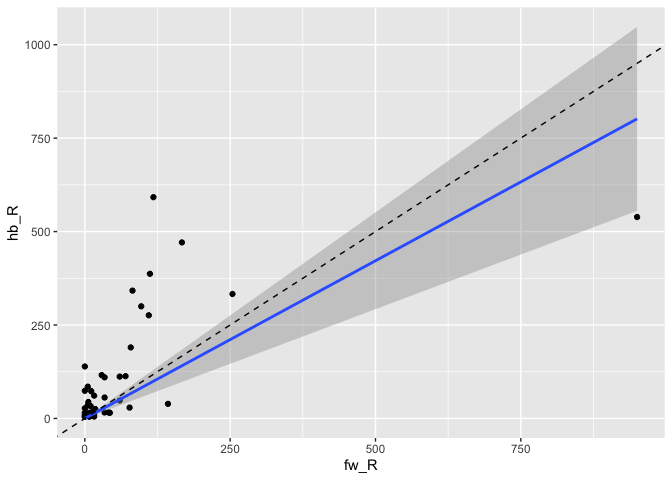
An R package from Greg Jefferis that puts one uniform interface over the major fly connectomes so the same partner-query or cell-type comparison can be run across hemibrain, FlyWire, MANC, FANC, BANC, the male CNS and the male optic lobe. It is flagged as experimental and its API may still change, but it is already the workhorse for hemibrain-versus-FlyWire comparisons in the natverse community.
connectome_data_prep
Yijie Yin, University of Cambridge
Yijie Yin's (Cambridge) notebooks and scripts for turning raw connectome releases into analysis-ready sparse connectivity matrices and metadata tables, with axon/dendrite splitting via flow centrality. It covers the adult male CNS, BANC, FlyWire/FAFB, hemibrain and MANC as well as the larval connectome, and includes benchmarking code for the pathfinding and effective-connectivity analyses used in the Connectome Interpreter framework. No license file is present.

fly-brain (Rojas)
Enrique Rojas Aliaga, Universidad de San Martín de Porres
A solo project from Enrique Rojas Aliaga at Universidad de San Martín de Porres (Lima) that wires a spiking network of 138,639 FlyWire v783 neurons and 15.1 million synapses into a NeuroMechFly v2 body in MuJoCo, complete with compound eyes, legs and wings. The author reports vision-driven motion detection, olfactory chemotaxis, gustatory responses and emergent walking, flight and escape, and frames the work around how connectome plus embodied experience yields individual behavioural differences; a 2026 preprint is archived on Zenodo.
Fly Connectome Data Tutorial (SJCABS)
SJCABS winter school (Sven Dorkenwald & Alexander Bates)
Course material from the San Juan Winter School on Connectomics and Brain Simulation, written by Sven Dorkenwald and Alexander Bates, that walks students from loading data to morphology, direct and indirect connectivity analysis in both Python and R. Its most useful feature is a harmonised metadata schema and a public cloud bucket covering BANC, FAFB, the male CNS, MANC and hemibrain, so the same notebooks run across all five datasets.
FlyWire Codex
Princeton Neuroscience Institute
A browser-based explorer developed at the Princeton Neuroscience Institute that lets anyone search, filter and visualise large connectomes entirely in the browser, with no local install or bulk download. Beyond FlyWire's own FAFB v783 (139,255 neurons) it now serves BANC v888, Janelia's MANC v1.2.1, the male optic lobe (MAOL v1.1) and the male CNS v1.0, and had passed 60,000 registered users by early 2026. The open-source code lives in the murthylab/codex repository under Apache-2.0.
malecns (R)
natverse / Jefferis lab with Janelia FlyEM
An R wrapper that gives natverse users convenient access to Janelia FlyEM's whole male central nervous system connectome (the public male-cns:v1.0 snapshot on neuPrint), including neuron meshes, annotation columns that cross-reference FlyWire and MANC cell types, and transforms between datasets. It grew out of the collaboration between the Janelia FlyEM team and the Cambridge Drosophila Connectomics Group and has been developed since late 2021.
natverse / nat
Jefferis lab, MRC LMB
A tidyverse-style family of interoperable R packages for importing, visualising, analysing and exporting 3D neuroanatomy, built around the core nat (NeuroAnatomy Toolbox) package that Greg Jefferis's group has maintained on GitHub since 2014. Satellite packages such as neuprintr and fafbseg give R users access to hemibrain and FlyWire/FAFB data. The ecosystem was described by Bates, Jefferis and colleagues in eLife in 2020.
Drosophila_brain_model (Shiu et al.)
Philip K. Shiu et al.
The reference code for Shiu et al., "A Drosophila computational brain model reveals sensorimotor processing" (Nature, October 2024), a leaky integrate-and-fire model of the whole FlyWire brain implemented in Brian 2. Users activate neurons by FlyWire ID with Poisson input or silence them to mimic optogenetics and read out spike times and rates; both the v630 and v783 connectome releases are supported and Jupyter tutorials are included. Later projects such as Eon Systems' fly-brain build directly on it.
flybrain (snedea)
snedea (GitHub user)
A browser-based simulation by GitHub user snedea that runs a leaky integrate-and-fire network of all 139,255 FlyWire FAFB v783 neurons and 2.7 million connections inside a Web Worker, letting visitors poke the fly with food, touch, wind, light and temperature and watch unscripted behaviour emerge from the wiring. It began in March 2026 as a scale-up of heyseth's 302-neuron C. elegans worm-sim and is hosted at flybrain.app.
Virtual Fly Brain
Virtual Fly Brain consortium (UK institutions incl. MRC HGU)
A long-running UK-funded web atlas that registers neuron images, gene-expression patterns and connectomics onto standard Drosophila brain templates and links them through an anatomy ontology, so anatomy, expression and connectivity can be cross-searched in one place. Supported since 2009, it now indexes over 600,000 3D images and roughly 490,000 neurons with connectivity, spanning hemibrain, FlyWire, FANC and the larval L1EM data. The v2 front end (geppetto-vfb) is an MIT-licensed customisation of the Geppetto platform.

Wikipedia: Drosophila connectome
Wikipedia (Wikimedia Foundation)
Community-written encyclopedia article that serves as a one-stop overview of fruit fly connectomics, explaining why Drosophila is used as a model and walking through the major datasets from the 3,016-neuron larval brain to the adult hemibrain, FlyWire, the FANC and MANC nerve cords, and the 2025 whole-CNS BANC and male CNS reconstructions. It also touches on how wiring structure relates to behavior. Text is under CC BY-SA 4.0; last edited August 11, 2026.