APIs, libraries and browsers for querying and visualising connectome data.
brandoncho369
A reflex benchmark that asks the question the demo wave mostly skips: does the simulated fly still do the things a real fly is known to do? It ships a suite of behavioural tasks with literature citations, a reference leaky integrate-and-fire simulator and a scoring harness, so any set of model parameters gets a comparable number. The framing is direct about why it exists, that every Minecraft or Doom demo had to guess at synaptic weight, global gain and inhibition and then hand-tune until something looked alive.
 navis-org/navis docs (GPL-3.0)
navis-org (Fly Connectomics group, Cambridge)
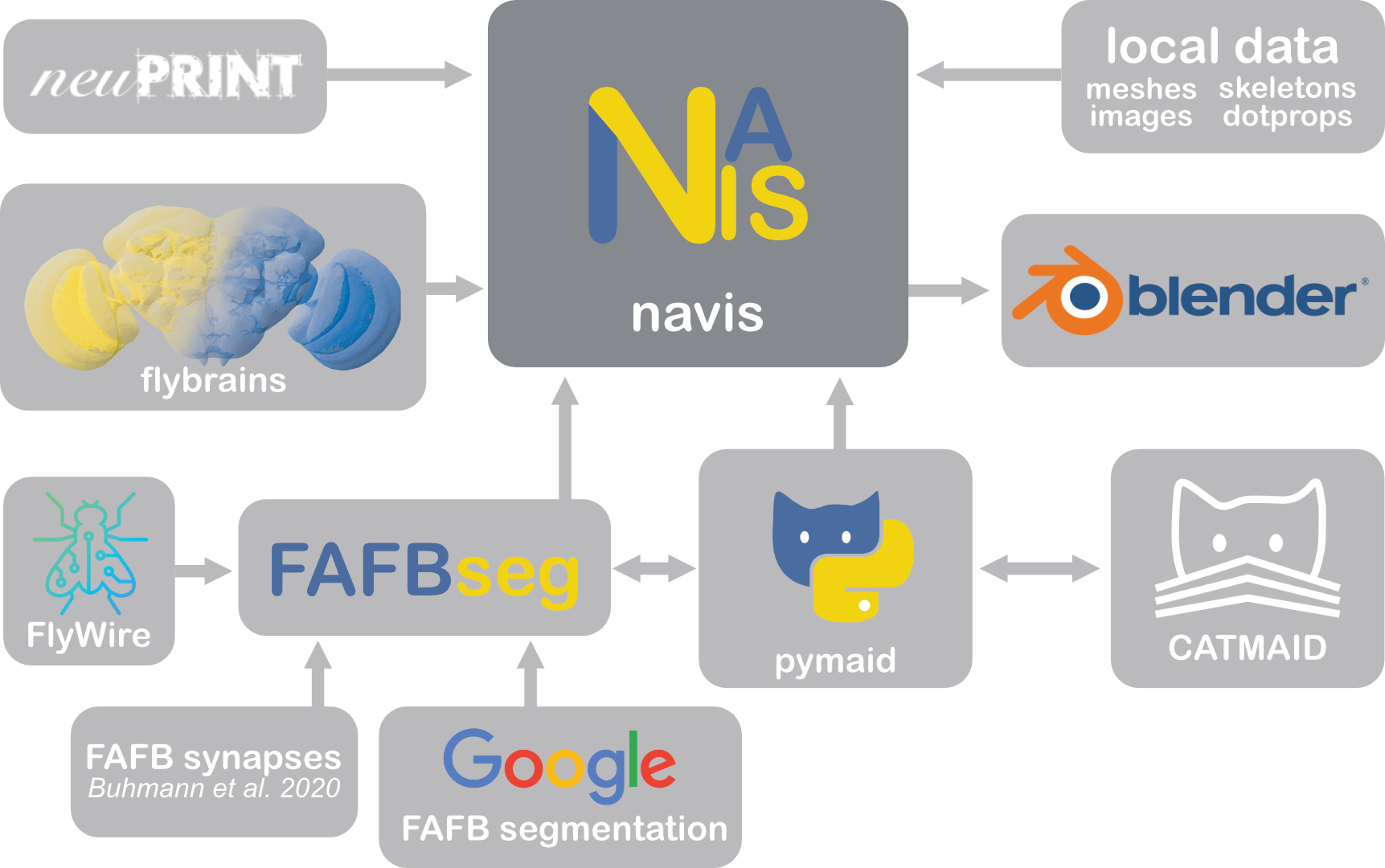
A general-purpose Python library for handling neuron skeletons, meshes, dotprops and image volumes, with 2D/3D plotting, morphometrics, NBLAST similarity and template-brain transforms built in. Developed in the Cambridge fly connectomics community as the Python counterpart of the R natverse, it plugs into neuPrint and, through the fafbseg extension, FlyWire/FAFB. Performance-critical pieces have been moved to Rust via navis-fastcore.
BruceLanLan
Takes one behaviour, looming-evoked escape gated by the giant fiber, and carries it from the MaleCNS v1.0 wiring through an explicit teacher model, then a 16-bit decision table covering all 65,536 rows, and finally a netlist of 173 NAND gates and 6 latches proved exhaustively equivalent to that table. The question is how small a deterministic machine reproduces a connectome-shaped behaviour, and how much of that machine can be proven rather than trusted. A browser bench launches a looming block at a fly and evaluates the netlist cell by cell every 5 ms, verifying its SHA-256 on load.
franciscocarloserra
Event-driven Triton kernels that step the whole MaleCNS connectome, 165,000 neurons and 24.5 million synapses, at 3,455 Hz on a single RTX 3090. With a 1 ms membrane time step that is one second of fly life in 0.29 seconds of wall clock, about 3.5 times faster than real time, against 708 steps per second for a torch.sparse COO baseline. Batching sixteen or sixty-four flies trades single-fly latency for throughput and reaches 51,159 fly-steps per second. The README is explicit that the same input produces the same spikes as the torch.sparse reference.
ashemag
An interactive 3D atlas of the adult male fly brain built from published MaleCNS geometry: 80 brain regions carrying 7,270,902 native source triangles, with exploded and paired-region views, plus 1,712 traced neurons at 2,180,126 segments and eight complete neuron meshes loaded on demand. Geometry is served locally and no API token is needed at runtime. Every asset carries its source URL and a SHA-256 checksum in an attribution manifest, and the page states that the cellular view is a selected collection illustrating morphology, not the whole population.
Mert Cobanov (@cobanov)
A browser workbench for starting your own fly-connectome experiment instead of rebuilding the scaffolding each time. It opens with 124,289 classified brain soma positions from MaleCNS v1.0 rendered without stretching the axes, plus the anatomical flybody mesh, and leaves the environment and the model as replaceable parts: training and inference stay in your own stack, and outputs are mapped back by neuron ID. The licence requires attribution in both the web UI and the repository.
Mert Cobanov (@cobanov)
A curated list of fly-connectome projects published on 12 September 2026, at the peak of the wave, grouped into games and control experiments, desktop flies and interactive worlds, language and art experiments, brain models and embodied simulation, datasets, analysis libraries and tutorials. Each line names the dataset used and flags whether the project runs a whole connectome or only a circuit subset, which makes it unusually useful for telling the serious entries apart from the quick ones.
Yijie Yin, University of Cambridge
A Python library that turns a wiring diagram into testable hypotheses about circuit function, and it runs on a laptop or in Colab even for whole-brain analyses of around 140,000 neurons. It computes polysynaptic effective connectivity between groups of neurons with or without signs, retrieves and plots the actual subcircuit between sources and targets, and exposes a differentiable connectome model. Installable from PyPI, with an accompanying preprint and Colab notebook.
nftechie (Alex Wormuth)
Couples a frozen language model to the retained MaleCNS v1.0 graph: token embeddings drive the fixed 166,700-node network, and a 278,528-parameter adapter reads its state to adjust the next-token scores of Liquid AI's LFM2.5-1.2B-Instruct. Only the adapter trains, against a parameter-matched direct-input control. The README puts the caveat in its first paragraph, that language ability comes from the pretrained model and this does not mean a biological fly understands language.
Turaga Lab, HHMI Janelia Research Campus
The official PyTorch implementation of Lappalainen et al., "Connectome-constrained networks predict neural activity across the fly visual system" (Nature, 2024): a deep mechanistic network of the fly visual system whose connectivity is fixed by the connectome while its parameters are trained on an optic-flow task. The wiring ships with the package as a FIB-25/FIB-19 medulla reconstruction, not one of the whole-brain datasets. It includes pretrained model ensembles, Colab tutorials and a framework for custom models; several browser demos in the September 2026 wave use it as their eye front end.
Reiser Lab, HHMI Janelia Research Campus
A browsable reference for the MaleCNS v1.0 cell types, generated from the dataset itself and published by the lab: one page per cell type with connectivity, region innervation and morphology. It is the resource the demo projects should be checking their named neurons against, since almost every game demo picks out descending neurons such as DNp01 or DNg100 by name without a way to see what those cells actually connect to.
 natverse/coconatfly README (GPL-3.0-or-later)
Gregory Jefferis (natverse)
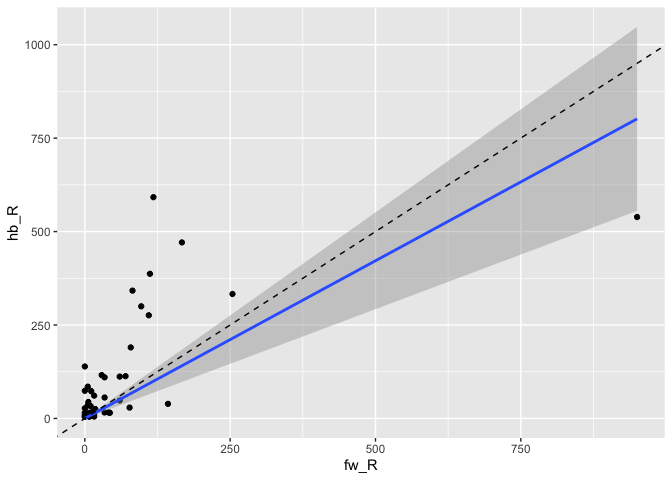
An R package from Greg Jefferis that puts one uniform interface over the major fly connectomes so the same partner-query or cell-type comparison can be run across hemibrain, FlyWire, MANC, FANC, BANC, the male CNS and the male optic lobe. It is flagged as experimental and its API may still change, but it is already the workhorse for hemibrain-versus-FlyWire comparisons in the natverse community.
Yijie Yin, University of Cambridge
Yijie Yin's (Cambridge) notebooks and scripts for turning raw connectome releases into analysis-ready sparse connectivity matrices and metadata tables, with axon/dendrite splitting via flow centrality. It covers the adult male CNS, BANC, FlyWire/FAFB, hemibrain and MANC as well as the larval connectome, and includes benchmarking code for the pathfinding and effective-connectivity analyses used in the Connectome Interpreter framework. No license file is present.
 sjcabs/fly_connectome_data_tutorial (MIT)
SJCABS winter school (Sven Dorkenwald & Alexander Bates)
Course material from the San Juan Winter School on Connectomics and Brain Simulation, written by Sven Dorkenwald and Alexander Bates, that walks students from loading data to morphology, direct and indirect connectivity analysis in both Python and R. Its most useful feature is a harmonised metadata schema and a public cloud bucket covering BANC, FAFB, the male CNS, MANC and hemibrain, so the same notebooks run across all five datasets.
Fly Connectomics group (Cambridge) & Jefferis lab (MRC LMB)
A README-only index of the software produced by the Cambridge Fly Connectomics group and the Jefferis lab at MRC LMB, useful as a map of the R natverse side (nat, neuprintr, hemibrainr, fafbseg, nat.flybrains) and the Python side (navis, pymaid, fafbseg, flybrains, skeletor). It was assembled in early 2022 and has not been updated since, so treat it as a snapshot rather than a live catalogue.
Princeton Neuroscience Institute
A browser-based explorer developed at the Princeton Neuroscience Institute that lets anyone search, filter and visualise large connectomes entirely in the browser, with no local install or bulk download. Beyond FlyWire's own FAFB v783 (139,255 neurons) it now serves BANC v888, Janelia's MANC v1.2.1, the male optic lobe (MAOL v1.1) and the male CNS v1.0, and had passed 60,000 registered users by early 2026. The open-source code lives in the murthylab/codex repository under Apache-2.0.
 natverse/malecns README (GPL-3.0)
natverse / Jefferis lab with Janelia FlyEM
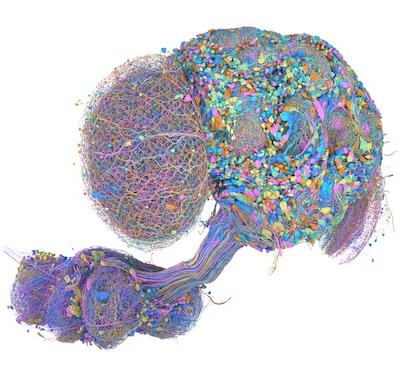
An R wrapper that gives natverse users convenient access to Janelia FlyEM's whole male central nervous system connectome (the public male-cns:v1.0 snapshot on neuPrint), including neuron meshes, annotation columns that cross-reference FlyWire and MANC cell types, and transforms between datasets. It grew out of the collaboration between the Janelia FlyEM team and the Cambridge Drosophila Connectomics Group and has been developed since late 2021.
Jefferis lab, MRC LMB
A tidyverse-style family of interoperable R packages for importing, visualising, analysing and exporting 3D neuroanatomy, built around the core nat (NeuroAnatomy Toolbox) package that Greg Jefferis's group has maintained on GitHub since 2014. Satellite packages such as neuprintr and fafbseg give R users access to hemibrain and FlyWire/FAFB data. The ecosystem was described by Bates, Jefferis and colleagues in eLife in 2020.
Janelia FlyEM (HHMI)
Janelia's connectome analysis ecosystem: a Neo4j-backed graph database plus the neuPrintExplorer web front end and an HTTP API for querying neurons and synaptic connectivity. It is the official home of the hemibrain, MANC and male CNS datasets from the FlyEM team, and the ecosystem was described in a 2022 Frontiers in Neuroinformatics paper by Plaza et al.
Janelia FlyEM (HHMI)
The official Python client for the neuPrint service, letting you pull neuron metadata, connectivity tables and skeletons from Janelia's connectome databases into pandas without writing Cypher by hand. First published on PyPI in January 2020 and still actively released (0.6.3 in July 2026), it is installable via pip, conda or pixi.
Virtual Fly Brain consortium (UK institutions incl. MRC HGU)
A long-running UK-funded web atlas that registers neuron images, gene-expression patterns and connectomics onto standard Drosophila brain templates and links them through an anatomy ontology, so anatomy, expression and connectivity can be cross-searched in one place. Supported since 2009, it now indexes over 600,000 3D images and roughly 490,000 neurons with connectivity, spanning hemibrain, FlyWire, FANC and the larval L1EM data. The v2 front end (geppetto-vfb) is an MIT-licensed customisation of the Geppetto platform.
 Fly Brain Hub