The "fly brain can play X" wave: games, desktop pets, music and other experiments.
Evan Sinclair Smith (@evnsnclr), Georgia Institute of Technology
A Minecraft fly driven by the full retained MaleCNS graph: 166,700 neurons and 25,582,938 directed edges, with six declared in-game inputs (player approach, nearby mobs, brushing, attack attempts, food, light) feeding the model and hand-chosen readouts selecting scripted body programs. The repository is currently a landing page and roadmap: the recorded demo exists, but the Fabric mod and companion source have not been published yet. The README is explicit that this shows a visible, testable mapping, not recovered fly physiology.
 DenisSergeevitch/desktop-fly README (MIT)
DenisSergeevitch
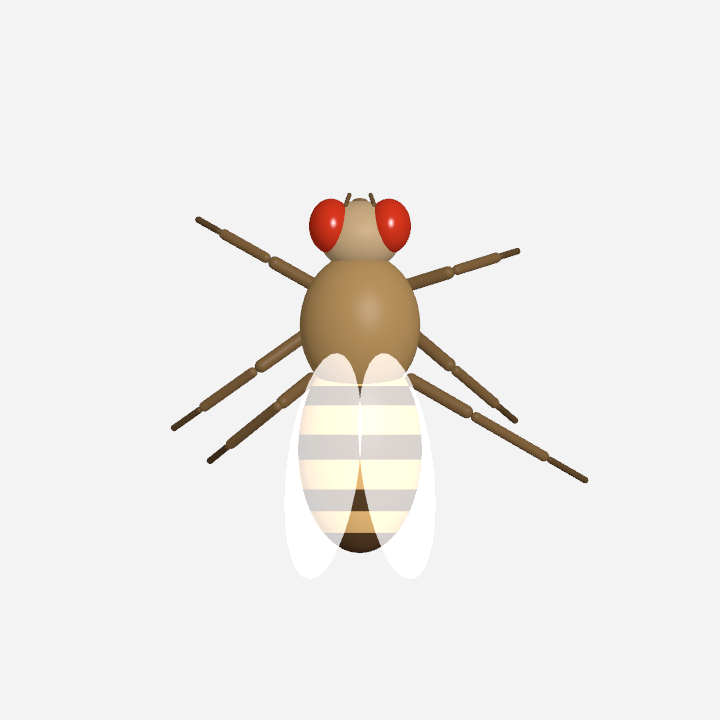
A 3D fruit fly living on the macOS desktop (Electron port for Windows), driven by a 1 kHz leaky integrate-and-fire simulation of two real circuits: a 668-neuron FlyWire subset for sensing, escape and decisions, and a 1,045-neuron MaleCNS descending-to-leg pathway ending in 220 motor neurons. Window edges act as terrain, window moves as threats and clicks as vibrations, and a separate window shows 23,210 neuron positions spiking live. The README is upfront that muscle mechanics are modeled rather than biologically calibrated; code is MIT, FlyWire data CC BY-NC 4.0 and MaleCNS CC BY 4.0.
nftechie (Alex Wormuth)
A MaleCNS v1.0 spiking simulation wired to a live Doom arena: each frame stimulates visual input neurons, activity propagates through 166,700 neurons, and motor output is decoded into movement and firing. The README is candid that learned survival has not been demonstrated yet.
 blendi-remade/fly-brain-minecraft README screenshot (MIT)
blendi-remade
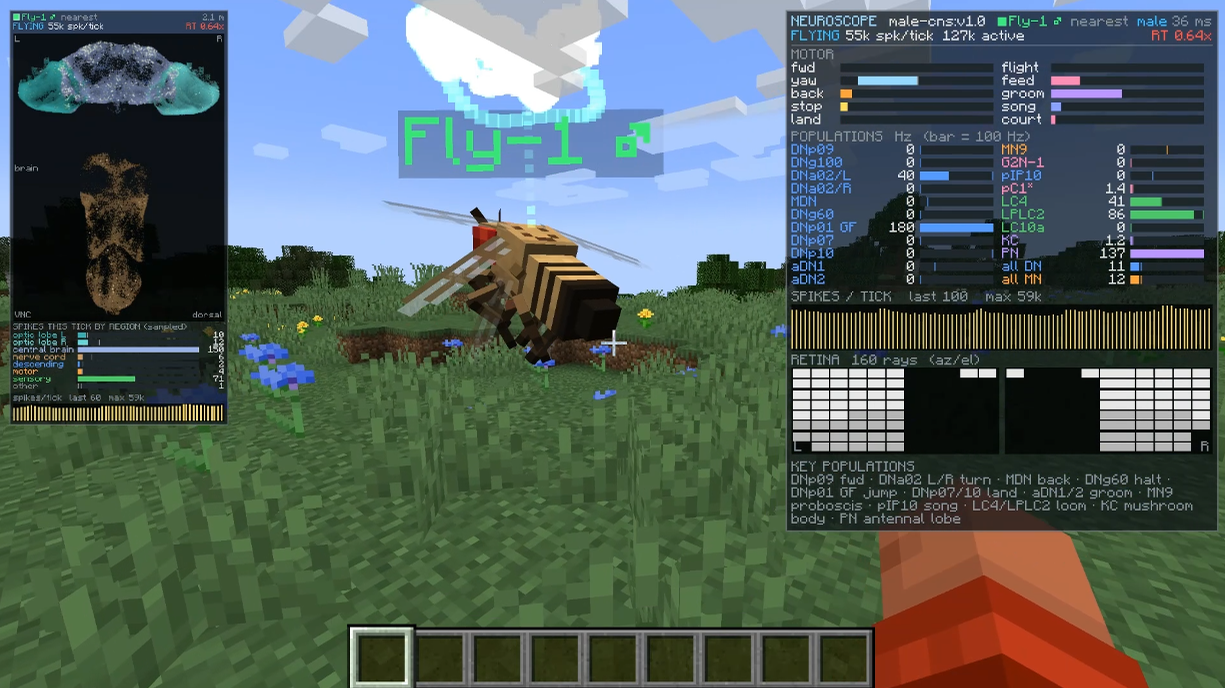
A Fabric mod for Minecraft 1.21.1 that runs the full neuPrint male-cns v1.0 connectome (about 176k neurons, 6.29M connections at 5+ synapses) as leaky integrate-and-fire units inside a fly mob, one thread per fly. In-game visual, smell, taste and touch stimuli feed sensory neurons, and decoded motor channels drive feeding, grooming, escape jumps, walking and flight. Includes a live brain-activity view, a HUD of population firing rates, and 56 JUnit tests; code is MIT, connectome data CC BY 4.0.
kevinlinxc
Plays the Bad Apple video into the MaleCNS v1.0 connectome and shows what a simulated body does in response: one pane projects neuron activity onto soma positions, the other drives a NeuroMechFly body in MuJoCo. The README opens with what it is not. The connectome is real, but the neurons are leaky integrate-and-fire units with invented parameters, not measured biophysics; the video is a spatial stimulation pattern across soma positions, not something the fly sees; there is no sensory feedback or aerodynamics; and the body mesh is the published female specimen paired with male neural data.
PtPavloTkachenko
Hologram flies placed in a real room through Snap Spectacles (2024), each running its own copy of the MaleCNS v1.0 connectome (166,700 neurons, 25.6 million synapses) as the leaky integrate-and-fire model of Shiu et al. 2024. The brains run on a Mac behind a Metal GPU kernel; the glasses turn the room into fly senses, streaming eyes, world mesh, hands and head to the brains, while descending and motor neurons come back to move wings, legs and head. The selected fly's brain is drawn live as a 16,000-neuron point cloud, and a decisions document lists every engineered part.
hcsolakoglu
A reduced MaleCNS circuit, 4,386 real neurons and 468,923 measured edges representing 4,210,625 synapses, controls a Fruit Ninja-style game through an explicit pixel to activity to blade loop. What earns it a place is the control set: you can switch between measured wiring, rewired wiring with its own refitted readout, connections cut, blinded input, a random blade and a plain pixel heuristic, with a seed for reproducible launches. The README says outright that this is a fixed-connectivity rate model with engineered visual and motor interfaces, not a whole-brain emulation.
fazchile17
A local 3D viewer of the FlyWire FAFB v783 connectome, 139,255 neurons, 15,091,983 directed pairs and 54,492,922 contacts, that paints either the Bad Apple!! animation or the shareware episode of DOOM using nothing but neurons as pixels. After a one-off data preparation of roughly 3 GB the viewer runs entirely offline on localhost; only the outbound links to Virtual Fly Brain and FlyWire need the network. Documentation is in Spanish. One of two independent Bad Apple entries from the same week.
Yusuftmle
An agent that plays Valve's Half-Life with no deep network, policy or reinforcement learning in the loop: every turn, jump and evasive move comes out of biophysical leaky integrate-and-fire circuits derived from MaleCNS v1.0 and FlyWire and simulated as sparse tensors. Frames are projected onto a 60x60 compound-eye retina and taking damage triggers a giant-fiber escape. The headline figure is the size of the source dataset; the graph actually stepped in the demo is a 12,260-neuron subgraph, shown beside the game with calcium-style activity and descending-neuron meters.
Unjuno
Connects the MaleCNS v1.0 connectome to the FightingICE fighting-game platform through a pinned implementation of the Shiu et al. leaky integrate-and-fire dynamics. Game observations become a versioned Poisson sensory interface, real output-body spike counts become versioned action groups, and a public research ledger records the runs. The repository draws an unusually sharp line between what is biological data (the anatomy), what is a published model (the dynamics) and what is a project-defined interface (the sensory and action mappings, reward and plasticity rules).
Liu Zihe (@liuzihe02)
Puts a connectome simulation into Craftax, an open-ended survival environment, and trains a linear descending-neuron readout with PPO. What sets it apart from most of the wave is the harness around it: a brain-only throughput benchmark, an MN9 sugar-response check against Shiu et al., a calibration sweep over lamina bias and synapse weight, zero-shot rollouts against ablation controls, and a replay of the trained readout on a held-out key versus an open-loop baseline. A research prototype, not a result.
Mert Cobanov (@cobanov)
The original Chromium Dino game played through an 80-cell measured MaleCNS circuit: eight engineered observations feed the fixed cells, 16 descending-cell activities feed a 16-12-3 readout, and only that 243-parameter readout is trained, using the cross-entropy method over 80 generations and 15,680 episodes. The published checkpoint clears 99/100 held-out 180-second courses; the same readout with the circuit silenced clears 0/100. The author states this shows learned control and dependence on circuit activity, not that biological topology is better.
David Zhang (@dzhng)
A 3D browser puzzle game: arrange household objects in a furnished house, release a swarm of flies, and see how many find the exit before time runs out. Each fly has its own simulated activity from a selected part of the MaleCNS connectome, running as Rust compiled to WebAssembly with a TypeScript world and interface; you can follow one fly, read its left/right color inputs and inspect its neural traces. The stated design rule is to build the game around observed behavior rather than forcing the neurons to produce a chosen strategy.
Matty (@mattyhempstead)
"Born to fly. Forced to scroll." A simulated fly watches an endless feed of insect Shorts on a virtual phone: the browser samples the phone image at 90x160 pixels, luminance and color stimulate 3,335 R1-R6 and 811 R8 inputs in the full MaleCNS v1.0 graph, and a compiled kernel advances 50 ms of neural time per accepted frame. The overlay charts the measured PAM11 dopamine firing rate in Hz alongside whole-network spike counts. Explicitly inspired by Stonkfly; body motion is an amplified readout, not a physics simulation.
Furkan Çakır (@furkancak1r)
A first-person horror prototype in Godot 4.5 where a physical fly shares the room with you: a MaleCNS v1.0 simulation (166,700 neurons, 25,582,938 directed connections) influences its flight while a separate reward-updated decision layer picks which scare events fire. The repository ships the built game, the data, a separate Python simulation, tests and measurement reports, and documents a pre-training run of 48 synthetic players over 576 rounds. The README is in Turkish.
Mark Unthank (@MarkUnthank)
Trains a model built from 165,122 traced MaleCNS neurons and 25,563,197 measured connections to physically operate a steering wheel through a simulated fly foreleg, then drives a car in CARLA. The reported pilot passed 100/100 held-out stationary steering targets after 600 optimizer updates and 0/100 before, with a worst hold error of 4.85 degrees against a predeclared 7.45-degree limit; removing the foot grip removes over 99 percent of the steering response. The README states that visual driving, combined wheel and pedal control, and three-seed replication remain untested.
 @sainimatic on X (photo, 2026-09-13)
Macroblock (@sainimatic)
A counterpoint to the wave of games that put the simulated fly through hostile environments: Macroblock announced a sim where the fly simply flies around and feeds forever among grass, trees and endless fruit. The post drew roughly 24,000 likes and was picked up by Dexerto and IBTimes as the trend's ethical reaction shot. The post announces work in progress, so which connectome it uses and how far it got are not established by the sources checked.
William Kelly (@cnqso)
A browser artwork rather than a game: 139,255 FlyWire neurons drive an embodied fly in a terrarium whose sweet-sensing neurons receive continuous stimulation, so it feeds forever. Feeding, head and antennal motion follow neural activity, while wing movements and small foot shuffles use supplied patterns; a corner map lights up sampled FlyWire positions as neurons fire. The author credits Harris Rosenblum's Infinite Pain (2025) as the inspiration and lists flybody, MuJoCo and Shiu et al. as the body and model references.
Pandu Sastrowardoyo (@Decentricity)
Drives a sparse MaleCNS reservoir with a live Muse EEG headset and renders the result in the terminal through libcaca, with a human scalp and band pane next to the fly visualisation. A synthetic EEG source lets it run without a headset. The README sets its own limits clearly: the reservoir dynamics are not biophysics, and the "fly EEG bands" are the spectral content of the digital reservoir rather than insect electrophysiology.
Xenova (Hugging Face)
A standalone Hugging Face Space where you paint neurons, stimulate the network and watch an articulated Three.js fly respond, all locally in the browser. It retains 166,700 MaleCNS entries and 25,582,938 directed connections and runs a leaky integrate-and-fire model adapted from Shiu et al. on WebGPU kernels, with a JavaScript fallback. The card is candid that the walking, turning and flight animations are crafted and illustrative, that gains and thresholds were chosen for the demo, and that body motion never feeds back into the network.
marketcalls
The trading branch of the wave, aimed at the Indian options market instead of crypto: the full MaleCNS v1.0 simulation is wired through OpenAlgo to one strategy, an intraday short straddle on the current-month NIFTY expiry, sized with volatility-based stop losses and flat by 15:15 daily. Prices and option chains come from the user's own OpenAlgo connection into a local DuckDB, with no mock data. Paper mode is the default, live mode needs an explicit opt-in, and the README states that no profitable edge has been demonstrated.
 ▶
▶Ro0oney (YouTube)
The YouTube video Know Your Meme credits as one of the earliest large posts of the September 2026 wave, with over 241,000 views in three days. The creator wires a fly connectome model to the behaviour of a Minecraft mob, first a spider and then a bee. The title's talk of transferred consciousness is showmanship: coverage describes a model of neural connections with a program mapping neurons to in-game decisions, and neither the dataset version nor the neuron-to-action mapping is documented in the sources checked.
hrook1
A browser arcade game where you try to swat a fly and watch its escape circuit light up before you click. It runs a simplified spiking model of 6,000 traced MaleCNS v1.0 neurons and 1,275,994 directed connections (preserving 10,659,685 original synaptic contacts), feeding simulated vision into an extracted LC16-to-MDN retreat circuit whose activity influences evasive turns and bursts. Baseline cruising, flight animation and collision rules are authored game mechanics, and the README says so plainly.
 ▶@_lyraaaa_ on X (video poster, 2026-09-12)
@_lyraaaa_
A short video posted on X by @_lyraaaa_ showing a simulated MaleCNS v1.0 fly brain hooked up to Beat Saber. It carries the highest view count Know Your Meme lists for the September 2026 wave, roughly 22 million views and 84,800 likes. Dexerto reports that the creator later clarified the video does not yet show the model independently playing: its motor system had been trained to reproduce a recorded sequence, while visual reactions and actual playing patterns were still being developed through reinforcement learning. Read the view count with that in mind.
 ▶@nftechie_ on X (video poster, 2026-09-12)
@nftechie_
A video post by Alex Wormuth (@nftechie_), the creator behind the earlier Doom livestream, giving a simulated fly brain $100 and using its neural activity to trigger buy and sell orders on Coinbase, with dopamine neurons stimulated whenever it profits. Know Your Meme reports about 3.4 million views. The author published Stonkfly the same day: prices become an RGB chart stimulating 3,335 brightness and 811 R8 inputs in the MaleCNS graph, a fixed readout proposes buy, sell or hold, and profit or loss stimulates PAM11 or PPL101 cells. It paper-trades by default and shows no profitable learning.
 ▶@barrelshifter on X (video poster, 2026-09-12)
ornata (Jessica Paquette, @barrelshifter)
Jessica Paquette's proof-of-concept that pipes Super Mario 64 frames (from a decompiled SM64 build) into a simulated visual system of a ~100k-neuron MaleCNS v1.0 model and reads controller inputs off named descending neurons: DNg100 for movement, a DNa02/DNg13 difference for steering, DNp01/DNp10 bursts for jumping. There is no learning or reward signal, and the README says the fly mostly walks into walls and gets stuck; the author calls it 100% vibe coded. Covered by Gizmodo on 2026-09-08.
 ▶@alright_mark on X (video poster, 2026-09-12)
@alright_mark
A joke-toned video post by @alright_mark presenting a simulated fly-brain system attempting the "ultimate test" of parallel parking a car. Know Your Meme reports roughly 1.5 million views and 16,000 likes for the 2026-09-10 post. The coverage fetched describes only the video and its caption, not the underlying setup or which connectome data, if any, is simulated.
Apolotary (Bektur Ryskeldiev)
An Ableton Live extension for macOS that turns the 1,045-neuron MaleCNS motor subset (borrowed from DesktopFly's data) into MIDI: simulated flies bounce around a Three.js scene and their collisions, contacts and motor values trigger notes or modulate ambient parameters across five modes, including a Dark Lab mode with a small learnable 70-weight readout. The author is careful to separate the measured circuit from the composed harmony, describing the flies as particles dressed up as flies. Written up on Sonic Field on 2026-09-10.
 Fly Brain Hub